Preparing for board exams involves more than memorising facts and choosing the correct MCQ option. Students also need to explain concepts, show calculations, organise answers and express their understanding clearly.
This is why subjective tests and objective tests both play an important role in board exam preparation. While objective tests help students check their knowledge quickly, written practice helps them develop the skills needed to answer descriptive questions confidently.
What Is the Difference Between Subjective and Objective Tests?
|
Feature
|
Objective Tests |
Subjective Tests
|
| Question types |
MCQs, true or false, matching and other objective formats |
Short answers, long answers, explanations and numerical problems |
| Main focus |
Recall, recognition and application, depending on the question |
Explanation, reasoning, working and written expression |
| Answer format |
Select or provide a specific answer |
Write and organise an answer |
| Practice benefit |
Helps check understanding and accuracy |
Helps improve answer writing and presentation |
| Evaluation |
Often quick and straightforward |
May require evaluation against a marking scheme |
Both formats are useful. The right balance depends on your subject, syllabus and examination pattern.
-
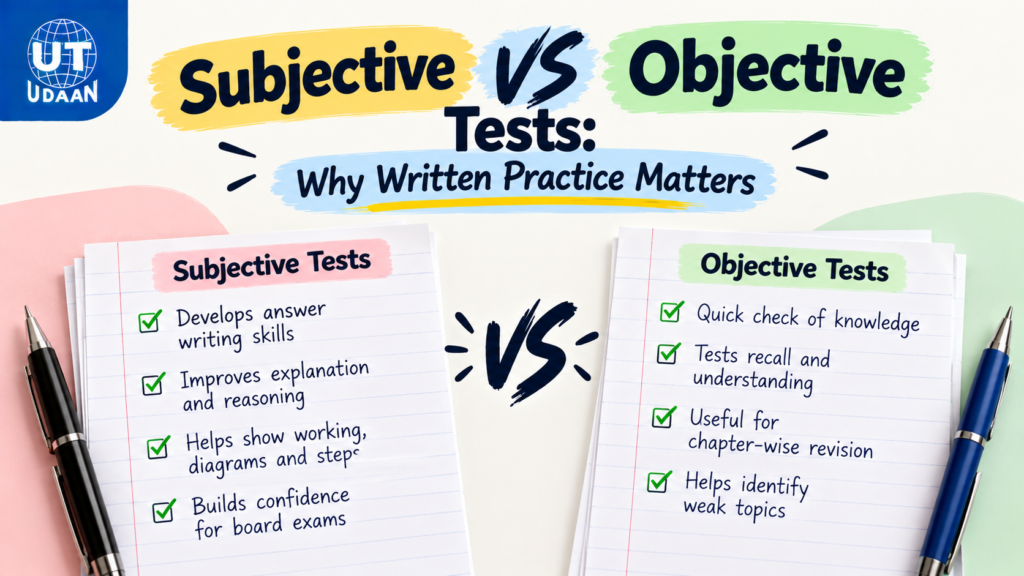
Objective Tests Help You Check Your Knowledge
Objective questions are useful for quick revision and identifying concepts that need more attention.
They help students:
- Revise important facts and definitions.
- Test their understanding of concepts.
- Practise applying formulas and identifying correct answers.
- Recognise weak topics before attempting longer questions.
However, selecting the correct option does not always mean you can explain the concept or solve a similar problem independently.
-
Subjective Tests Teach You How to Write Answers
In board exams, students often need to explain their reasoning, show calculations, draw diagrams or present answers in a structured format.
Written practice helps you learn to:
- Explain concepts using relevant keywords.
- Show mathematical steps and calculations.
- Write answers according to the marks and requirements of the question.
- Present diagrams with appropriate labels.
- Organise answers into clear, relevant points.
- Manage time while completing a written paper.
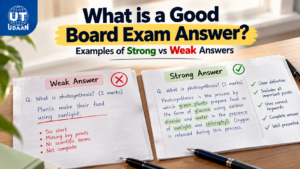
Knowing an answer and writing a complete answer are two different skills. Subjective practice helps you develop both.
-
Why Written Practice Matters before Board Exams
Reading a textbook or solving MCQs can help you understand a topic, but neither fully replaces writing a complete answer yourself.
For example, you may know the formula for a Mathematics problem. During a written test, you must also apply it correctly, show relevant working and present the final answer clearly.
Similarly, in Science or Social Science, you may remember a concept but still miss important points while explaining it.
Regular written practice helps you identify these gaps before the actual examination.
-
Common Mistakes Students Make
Avoid these mistakes during board exam preparation:
- Practising only MCQs: Include written questions wherever your examination requires them.
- Reading answers instead of writing them: Test whether you can reproduce and explain concepts independently.
- Ignoring time limits: Practise completing papers within the prescribed duration.
- Checking only the final score: Review every mistake and understand why marks were lost.
- Repeating tests without revision: Correct your weak areas before attempting another test.
-
How to Combine Objective and Subjective Practice
You do not need to choose one format over the other. Use both strategically.
Follow this simple routine:
- Revise the chapter: Understand the concepts, definitions and formulas.
- Attempt objective questions: Check your recall and understanding.
- Practise written questions: Solve numericals and write short and long answers.
- Take a timed mock test: Practise according to the relevant board examination pattern.
- Analyse your mistakes: Identify weak concepts and answer-writing problems.
- Revise and practise again: Check whether you have improved.
This approach helps you build conceptual understanding alongside written examination skills.
Practise with UT Udaan
UT Udaan helps students prepare through chapter-wise tests and board-pattern mock tests, giving them opportunities to practise questions under test conditions.
Students can use their test performance to identify weak concepts, improve answer writing, revise mistakes and practise again.
UT Udaan provides structured test practice for students across different classes and boards. Choose the test series according to your class and board:
Final Takeaway
Objective tests help you check your knowledge, while subjective tests help you practise expressing that knowledge in writing. Both can support effective board exam preparation.
For better results, combine revision, objective questions, written practice and careful analysis of corrected papers.
Practise. Evaluate. Improve. Repeat. With UT Udaan.