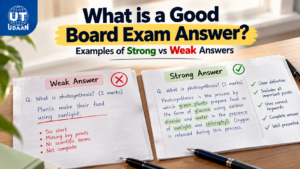
Writing the correct answer is important, but how you present it can also make a difference in board exams.
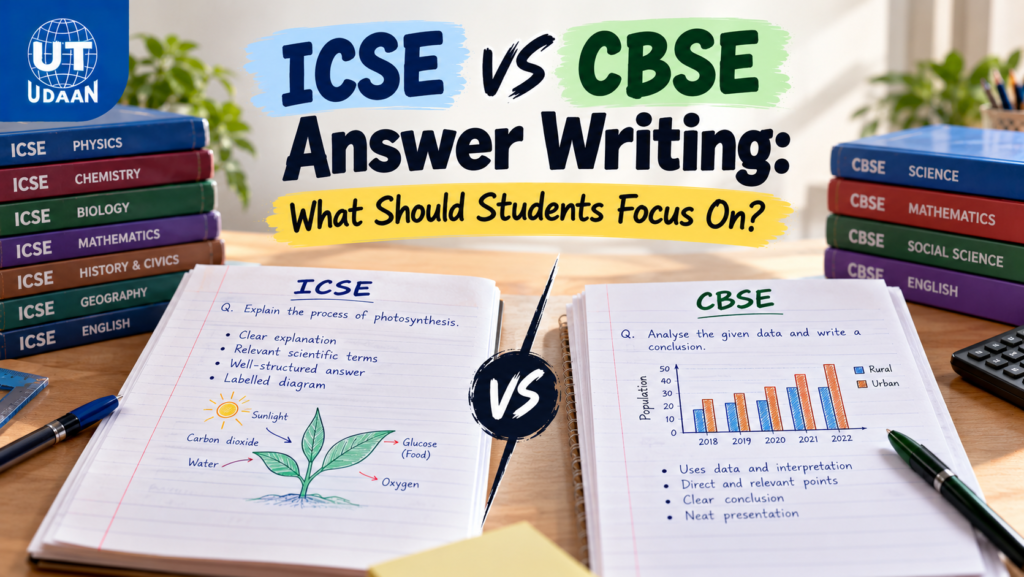
ICSE and CBSE students both need clear concepts, accurate information and well-structured answers. However, the way students approach different question types, explanations and subject-specific requirements may vary.
So, if you are preparing for the Class 10 Board Exams, here is what you should focus on to improve your answer-writing skills.
1. ICSE vs CBSE: What Is the Difference in Answer Writing?
Both boards assess students according to the prescribed syllabus, question paper and marking scheme. The exact requirements depend on the subject and question.
|
Focus Area
|
ICSE Class 10 |
CBSE Class 10
|
| Explanations |
Practise detailed, relevant explanations where required |
Practise clear, concept-based explanations where required |
| Keywords |
Use precise subject terminology |
Use accurate terminology and key concepts |
| Mathematics |
Show logical working and necessary steps |
Show relevant working, formulas and calculations |
| Science |
Practise definitions, reasoning, diagrams and structured answers |
Practise scientific explanations, application-based questions and diagrams |
| Social Studies |
Organise answers into clear, relevant points |
Focus on direct, well-structured answers and question requirements |
| Presentation |
Use headings, points and diagrams where appropriate |
Use headings, points and diagrams where appropriate |
Important: Neither board follows a single answer-writing style for every subject. Always follow the instructions and marking scheme applicable to your paper.
2. What Should ICSE Students Focus On?
ICSE students should practise writing answers that are accurate, relevant and sufficiently detailed for the question.
Focus on:
- Explaining concepts clearly instead of memorising isolated lines.
- Including important keywords and subject-specific terms.
- Showing complete working in Mathematics.
- Practising structured answers in Biology, Chemistry and Physics.
- Writing organised, relevant points in History and Geography.
- Drawing accurate diagrams and labelling them wherever required.
The goal is to provide enough detail to answer the question completely without adding unnecessary information.
3. What Should CBSE Students Focus On?
CBSE students should focus on understanding concepts and applying them to different question formats.
Practise:
- Answering competency-based and case-based questions.
- Explaining reasoning instead of writing unsupported conclusions.
- Showing formulas and relevant calculations.
- Writing concise answers that address the question directly.
- Using appropriate scientific and subject-specific terminology.
- Interpreting data, diagrams, graphs and source-based information where applicable.
Remember, a short answer is not automatically a good answer. It must contain the points required by the question.
4. Common Answer-Writing Mistakes Students Should Avoid
Regardless of the board, students should watch out for these mistakes:
- Writing without understanding the question: Identify whether you need to define, explain, compare, justify or calculate.
- Missing key points: Check whether your answer addresses every part of the question.
- Skipping working: Show relevant steps in numerical and mathematical problems.
- Adding unnecessary information: Stay focused on what has been asked.
- Ignoring presentation: Use clear steps, paragraphs, headings or diagrams when appropriate.
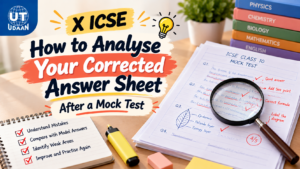
- Not reviewing mistakes: Analyse corrected mock-test papers to understand where marks were lost.
5. How Can Mock Tests Improve Answer Writing?
Reading model answers is useful, but writing answers yourself helps you identify practical difficulties.
Attempting board-pattern mock tests helps you practise writing within a time limit, organising answers and managing a complete paper.
After every test, review your corrected answer sheet and ask:
- Did I include all the important points?
- Was my explanation clear?
- Did I show the necessary steps?
- Where did I lose marks?
- How can I improve this answer next time?
Follow this cycle: Attempt → Evaluate → Identify Mistakes → Improve → Practise Again
Practise with UT Udaan
UT Udaan helps students prepare through chapter-wise tests and board-pattern mock tests, giving them opportunities to practise questions under test conditions.
Students can use their test performance to identify weak concepts, improve answer writing, revise mistakes and practise again.
UT Udaan provides structured test practice for students across different classes and boards. Choose the test series according to your class and board:
Final Takeaway
ICSE and CBSE students should not focus only on how much they study. They should also practise how effectively they communicate what they know.
Understand the question. Write accurately. Show your working. Learn from every correction.
With regular practice and careful evaluation, you can develop stronger answer-writing skills for your board exams.
UT Udaan — Practise. Evaluate. Improve. Repeat.