ICSE Class 10 Social Studies can feel overwhelming because it combines History, Geography, Civics and Economics, with dates, events, definitions, locations, concepts and long-answer questions to prepare. Each subject requires a slightly different approach, and students often find it difficult to remember a large amount of information while also developing the ability to write clear, well-structured answers in the board examination.
But preparing for ICSE Class 10 Social Studies is not about memorising every line of the textbook. The key is to understand concepts, organise information and use effective recall techniques so that you can remember and reproduce important points during the board examination.
With the right Social Studies memory techniques, you can remember important facts for longer, revise faster, improve your answer-writing skills and approach your board examination with greater confidence.
Learn smart. Practise consistently. Revise strategically. Score confidently.
How Should You Study ICSE Class 10 Social Studies?
To prepare effectively for ICSE Class 10 Social Studies:
Understand → Organise → Recall → Practise → Revise
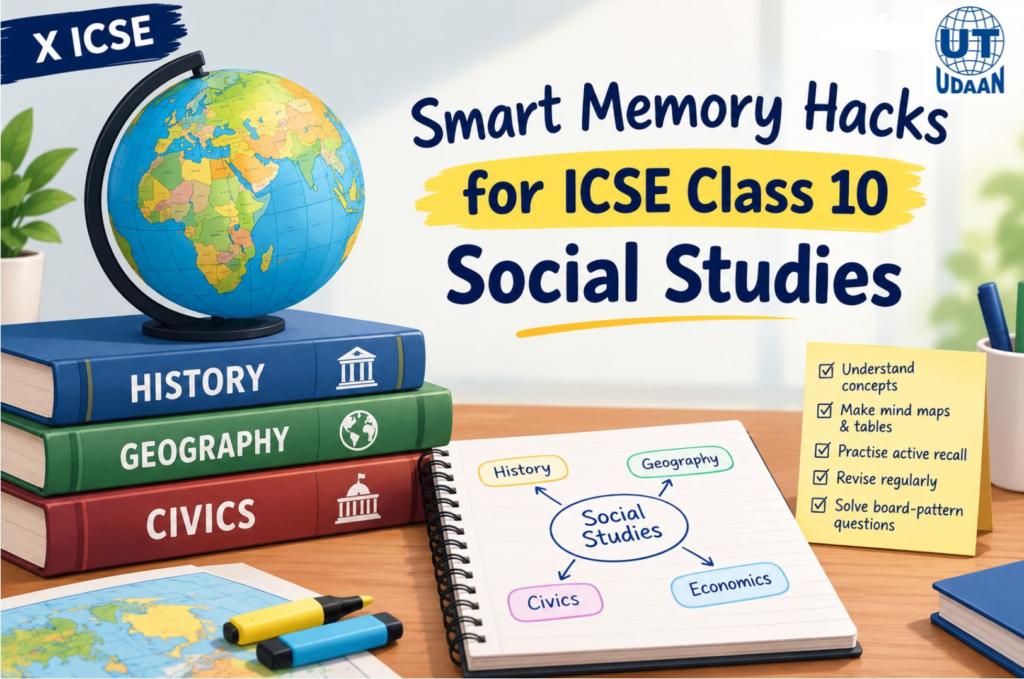
Use timelines for History, maps for Geography, comparison tables for Civics and Economics, active recall for facts and concepts, and regular board-pattern questions to test your preparation.
Instead of simply reading chapters repeatedly, make your preparation active. Understand the topic first, organise important information, recall it without looking at the textbook, practise different question types and revise at regular intervals.
For additional board-level practice, you can also use https://utudaan.com/icse-class-10-test-series/ to practise under examination-like conditions.
1. Understand the Story Before You Memorise
One of the biggest mistakes students make is trying to memorise a chapter word-for-word.
Instead, first understand the story, sequence and connection between events.
For example, while studying a History chapter, ask:
What happened? → Why did it happen? → Who was involved? → What was the result?
Once you understand the sequence, individual facts become much easier to remember.
Memory Formula: Cause → Event → Effect → Result
Use this pattern whenever you study historical events.
For example, when studying a movement or important historical event, identify its causes, understand what happened, remember the major people or organisations involved and finally revise its effects.
2. Turn Long Answers into Keywords
You do not need to memorise an entire paragraph.
Break every long answer into 4–5 important keywords and then use those keywords to reconstruct the explanation.
Example:
Question: Why was the Non-Cooperation Movement launched?
Instead of memorising a long paragraph, remember:
Rowlatt Act → Jallianwala Bagh → Khilafat → Swaraj → British goods boycott
Now use these keywords to reconstruct the answer in your own words.
Remember:
Keywords help you remember the answer.
Explanation helps you score the marks.
This technique is particularly useful when preparing for long-answer questions because it reduces the amount of information you need to memorise word-for-word.
3. Use Mind Maps to Revise ICSE Class 10 Social Studies
Mind maps are excellent for Social Studies because they turn large amounts of information into a simple visual structure.
Use mind maps for History timelines, Geography concepts, Civics institutions and Economics terminology.
For example:
INDIAN NATIONAL MOVEMENT
- Causes
- Important Leaders
- Major Movements
- Important Events
- Methods
- Results
- Impact
A single mind map can help you revise an entire chapter quickly.
Smart Tip:
Create your mind map after completing a chapter, not before. This forces your brain to recall what you have learned and helps you identify areas that still need revision.
4. Remember Dates with Events, Not Numbers
Dates can be difficult to remember when studied separately.
Instead, connect every important date with the event associated with it.
For example:
1919 → Jallianwala Bagh Massacre
1930 → Civil Disobedience Movement / Dandi March
1942 → Quit India Movement
1947 → Independence
Think of the date and event as a single memory unit.
Try This:
Cover the dates and recall them from the events.
Then cover the events and recall them from the dates.
This two-way recall technique strengthens memory and helps you retrieve information more quickly.
You can also create a simple History timeline and revise it regularly rather than trying to learn all dates together before the examination.
5. Use Maps as Memory Tools
Geography becomes much easier when you stop learning locations only from written notes.
Use this simple method: Look → Locate → Label → Recall
Practise important locations repeatedly on an outline map.
For example, while studying industries, minerals or agricultural regions, connect:
Location + Resource + Reason
Instead of simply memorising a place, ask:
Where is it? What is found there? Why is it important?
This creates stronger associations and improves map-based question preparation.
For additional practice, regularly include map-based questions while preparing for your: https://utudaan.com/icse-class-10-test-series/ .
6. Create Comparison Tables
Whenever two concepts are similar, create a comparison table.
For example:
| Feature |
Primary Sector |
Secondary Sector |
| Main activity |
Uses natural resources |
Processes raw materials |
| Example |
Agriculture |
Manufacturing |
| Output |
Raw materials |
Finished/semi-finished goods |
Comparison tables are particularly useful for Civics and Economics, where students often confuse similar concepts.
Instead of reading two definitions repeatedly, place them side by side and identify their differences.
7. Use the “Teach Someone” Method
One of the most powerful memory hacks is simple:
Teach the topic to someone else.
After studying a chapter, close your book and explain the concept as if you are teaching a younger student.
If you cannot explain it clearly, you probably need to revise that concept.
You can even teach:
- An imaginary student
- A friend
- A parent
- Yourself in front of a mirror
The Rule:
If you can explain it simply, you probably understand it well.
Teaching forces you to organise your thoughts and identify gaps in your understanding.
8. Practise Active Recall
Reading the same chapter again and again may feel productive, but it does not always improve recall.
Instead, close the book and ask yourself questions.
Try:
What were the main causes?
What happened next?
Who were the important people?
What were the consequences?
Can I explain this concept without looking at my notes?
This is called active recall, and it is a useful way to strengthen your ability to retrieve information from memory.
You can combine active recall with your daily revision routine for better retention.
9. Use Spaced Revision
Do not study a chapter once and leave it until the exam.
Use short, repeated revision sessions.
Simple Revision Cycle:
Day 1: Learn the chapter
Day 2: Quick recall
Day 4: Revise keywords
Day 7: Solve questions
Day 14: Take a short test
Before Exam: Final revision
The aim is not to spend hours rereading.
The aim is to recall information repeatedly at increasing intervals.
You can adjust this schedule according to your school tests, prelims and board examination timetable.
10. Turn Every Chapter into Questions
After finishing a chapter, create questions from its headings.
For example:
Heading: Causes of an event
Turn it into:
“What were the main causes of the event?”
Heading: Effects of an event
Turn it into:
“What were the major effects of the event?”
This transforms passive reading into active preparation.
It also helps you anticipate the types of questions you may need to answer in an examination.
11. Remember with Mnemonics
Mnemonics can help you remember lists, sequences and categories.
Create a simple word, phrase or sentence using the first letters of important points.
The mnemonic does not have to be perfect. It only needs to trigger your memory.
Smart Tip:
Create your own mnemonics.
Personal associations are often easier to remember because you have created the connection yourself.
However, use mnemonics as a memory aid—not as a replacement for understanding the concept.
12. Practise ICSE Class 10 Social Studies Board-Pattern Questions
Memory becomes stronger when you use information to answer questions.
After completing a chapter, practise:
- MCQs
- Assertion-Reason questions
- Case-based questions
- Source-based questions
- Short-answer questions
- Long-answer questions
- Map-based questions
Do not only check whether your answer is correct.
Also ask:
Did I include the required keywords?
Did I answer exactly what was asked?
Did I explain each point clearly?
Did I follow the required answer format?
Regular written practice can help you improve not only recall but also speed, accuracy and answer-writing skills.
Subject-Wise Strategy for ICSE Class 10 Social Studies
Different parts of Social Studies require different memory strategies. Instead of using the same technique for every subject, adapt your preparation.
History: Build Timelines and Connections
History becomes easier when you connect causes, events, personalities, movements and consequences.
Use:
- Timelines for important dates
- Cause-and-effect chains
- Keyword-based answers
- Event-to-date recall
- Short chapter summaries
- Regular question practice
Do not learn dates in isolation. Connect each important date to an event and revise the sequence regularly.
Geography: Learn Through Maps and Associations
For Geography, visual memory can be particularly useful.
Use:
- Outline maps
- Location-based revision
- Tables for resources and industries
- Cause-and-effect relationships
- Diagrams and flowcharts
- Regular map practice
When learning a location, do not only ask “Where is it?” Also ask “Why is it important?”
This creates a stronger connection between location and concept.
Civics: Focus on Institutions, Functions and Differences
Civics contains several concepts, institutions, powers, functions and differences that can become confusing if studied only through paragraphs.
Use:
- Comparison tables
- Flowcharts
- Keywords
- Question-and-answer cards
- Active recall
For example, when studying institutions, organise information under headings such as:
Composition → Powers → Functions → Role → Limitations
This makes revision faster and helps you structure answers clearly.
Economics: Connect Terms with Examples
Economics contains many terms and concepts that are easier to remember when connected with examples.
Use:
- Definitions + examples
- Comparison tables
- Keyword lists
- Concept maps
- Active recall
- Board-pattern questions
Whenever you learn an economic term, ask:
What does it mean? → What is an example? → How is it different from a similar term?
This approach can make difficult terminology easier to recall.
The 5-Minute Social Studies Memory Test
Before moving to another subject, spend just five minutes testing yourself.
Close your book and write:
3 important facts
2 important dates/events
2 key terms
1 question you can answer confidently
If you struggle, revisit that section immediately.
This small habit can make revision more active and help you identify weak areas before they become bigger problems.
Common Mistakes Students Should Avoid
❌ Reading without Recalling
Reading repeatedly does not guarantee that you can reproduce the information in the exam.
❌ Memorising Entire Paragraphs
Focus on keywords + concepts + explanation instead.
❌ Leaving Revision until the Last Week
Memory benefits from repeated exposure, so start revision early.
❌ Ignoring Maps
Map-based preparation requires regular practice.
❌ Only Solving Questions before the Exam
Practise questions throughout your preparation instead of waiting until the final days.
❌ Using the Same Study Method for Every Subject
History, Geography, Civics and Economics contain different types of information. Use timelines, maps, tables, flowcharts and examples according to the topic.
Smart Social Studies Revision Formula
Remember this simple formula:
Understand → Organise → Recall → Practise → Revise
Understand: Know what the topic means.
Organise: Use tables, timelines, flowcharts and mind maps.
Recall: Close the book and retrieve information from memory.
Practise: Solve different board-style questions.
Revise: Return to the topic at regular intervals.
This five-step approach can turn Social Studies preparation from passive reading into active learning.
Final Word
Social Studies does not have to be difficult to remember. The key is to use a smart memory strategy instead of trying to memorise every sentence from the textbook.
For ICSE Class 10 Social Studies, focus on understanding concepts, connecting events and facts, organising information through mind maps and tables, remembering important keywords, practising active recall, revising at regular intervals and solving board-pattern questions.
Never Just Read Social Studies. Recall It. Connect It. Practise It.
When you actively recall what you have studied, connect related ideas and practise writing answers, you can make revision more structured and effective. Use timelines, flowcharts, comparisons, keywords, maps and self-testing to make your preparation more organised.
Learn smart. Practise consistently. Revise strategically. Score confidently.
For additional ICSE Class 10 board-level practice, solve mock tests regularly to improve your speed, accuracy, answer-writing skills and exam confidence. Use your test performance to identify topics that need more revision and practise them again.
👉 ICSE Class 10 Mock Tests: https://utudaan.com/icse-class-10-test-series/
👉 UT Udaan: https://utudaan.com/
👉 FAQs: UT Udaan FAQs
Write Smarter. Score Better. Be the BEST!
Frequently Asked Questions About ICSE Class 10 Social Studies
1. How can I study ICSE Class 10 Social Studies effectively?
Study Social Studies using a combination of understanding, organisation, active recall, question practice and spaced revision. Use timelines for History, maps for Geography, comparison tables for Civics and Economics, and regular board-pattern questions to test your preparation.
2. How can I remember History dates for ICSE Class 10?
Do not memorise dates as isolated numbers. Connect each date with its event, cause or consequence. Create timelines and practise recalling the date from the event and the event from the date.
3. How can I remember long answers in Social Studies?
Break long answers into 4–5 keywords or key points. Understand what each keyword means and then practise reconstructing the complete answer in your own words.
4. How should I prepare for ICSE Class 10 Geography?
Combine textbook learning with maps, diagrams, tables, location-based associations and regular question practice. Pay attention to both factual information and the reasons behind geographical patterns.
5. How important are maps in ICSE Class 10 Geography?
Maps are an important part of Geography preparation. Practise locating and identifying important features regularly instead of leaving map work until the final revision.
6. How can I revise ICSE Social Studies quickly?
Use mind maps, timelines, keywords, comparison tables and active recall. Instead of rereading entire chapters, focus on recalling important facts, concepts and questions without looking at your textbook.
7. How can I score 90+ in ICSE Class 10 Social Studies?
Build strong conceptual understanding, revise consistently, practise different question types and improve your answer-writing technique. Regularly identify weak areas and revise them rather than repeatedly studying only the topics you already know.
8. How can I score 95+ in ICSE Class 10 Social Studies?
To aim for 95+, focus on concept clarity, accurate recall, complete answers, relevant keywords, map practice, regular revision and board-pattern question practice. Analyse your mistakes after every test and work specifically on areas where you lose marks.
For additional practice, you can use https://utudaan.com/icse-class-10-test-series/ to practise your preparation under test conditions.
9. How many times should I revise Social Studies before boards?
There is no fixed number that works for every student. Instead of counting revisions, use multiple short revision cycles. Revise soon after learning a topic, then return to it after increasing intervals and test yourself regularly.
10. Are mock tests useful for ICSE Class 10 Social Studies?
Yes. Mock tests provide an opportunity to practise time management, question selection, answer writing, recall and examination strategy. After completing a test, analyse your mistakes and use them to plan your next revision.
https://utudaan.com/icse-class-10-test-series/ can be used for additional board-level practice.