Are you preparing for the ICSE Class 10 Board Exams 2027 by memorising textbook answers? If yes, it may be time to rethink your preparation strategy!
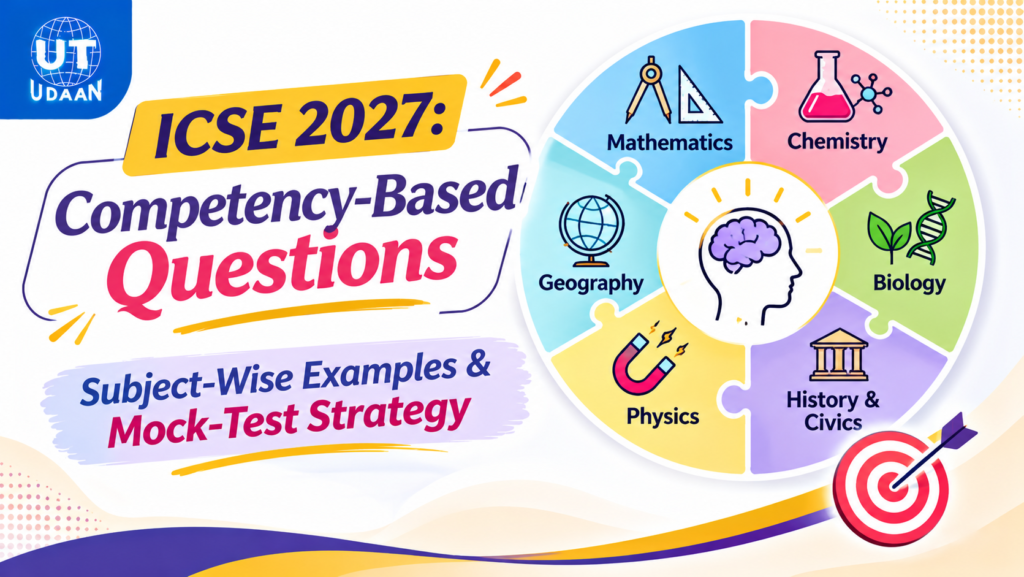
The Council for the Indian School Certificate Examinations (CISCE) is placing greater emphasis on competency-based assessment. For the 2027 examinations, approximately 50% weightage has been allocated to questions assessing higher-order competencies, including Application, Analysis, Evaluation and Creation.
This means students must be prepared to do more than remember definitions, formulas and textbook explanations. They should also know how to apply concepts, interpret information, analyse situations and justify their answers.
So, what does this change mean for ICSE Class 10 students? What types of questions should they practise? And how can mock tests help them prepare?
Let’s understand.
-
What Is Changing in ICSE 2027?
Traditionally, students often prepared for examinations by memorising definitions, learning textbook explanations and practising direct questions.
These methods are still important, but they are not enough on their own.
Competency-based assessment focuses on how well students understand and use what they have learned.
For ICSE 2027, CISCE has indicated approximately 50% weightage for higher-order competencies such as:
- Application: Using a learned concept to solve a problem or handle a new situation.
- Analysis: Breaking down information, identifying relationships and understanding patterns.
- Evaluation: Examining information, making judgements and supporting conclusions with reasons.
- Creation: Combining knowledge and ideas to develop a solution, explanation or outcome.
The remaining assessment also requires students to build a strong foundation in subject knowledge and understanding.
The important point is that students should not depend entirely on memorisation. They must practise using their knowledge in different situations.
-
What Does a Competency-Based Question Look Like?
A direct question generally checks whether you remember a concept. A competency-based question checks whether you can use that concept.
Let’s understand the difference through subject-wise examples.
Mathematics: From Formula Application to Problem-Solving
Direct question: Find the roots of the quadratic equation: (x2-5x+6=0)
Competency-based question: The area of a rectangular garden is 48 m². Its length is 2 m more than its breadth. Form a quadratic equation and calculate the dimensions of the garden.
What is being tested?
- Understanding the relationship between length, breadth and area.
- Forming a quadratic equation.
- Applying the correct mathematical method.
- Interpreting the final answer in the given situation.
Students must understand when and how to use a formula rather than simply memorising it.
Physics: From Remembering Laws to Applying Concepts
Direct question: State Ohm’s Law.
Competency-based question: A student connects a resistor to a battery and observes that the current increases when the potential difference is increased. Explain this observation using Ohm’s Law. What happens to the current if the resistance remains constant and the potential difference is doubled?
What is being tested?
- Understanding the relationship between potential difference, current and resistance.
- Applying the formula (V=IR).
- Explaining the result using scientific reasoning.
Chemistry: From Memorising Reactions to Understanding Them
Direct question: What happens when an acid reacts with a metal?
Competency-based question: A student adds dilute hydrochloric acid to a metal sample and observes the evolution of a gas. Explain how the student can identify the gas and write a balanced chemical equation for a suitable metal.
What is being tested?
- Understanding the reaction between metals and acids.
- Identifying the gas evolved.
- Applying the correct chemical equation.
- Explaining the observation.
Biology: From Learning Definitions to Interpreting Situations
Direct question: Define transpiration.
Competency-based question: A potted plant is kept under two different conditions. One plant is placed in a humid environment, while the other is placed in a dry environment. Predict which plant is likely to show a higher rate of transpiration and explain why.
What is being tested?
- Understanding the process of transpiration.
- Applying knowledge of environmental factors.
- Predicting an outcome.
- Supporting the answer with scientific reasoning.
History and Civics: From Memorising Events to Understanding Their Significance
Direct question: State two causes of the Revolt of 1857.
Competency-based question: A student is given a historical extract describing the grievances of Indian soldiers before the Revolt of 1857. Identify two factors from the extract that contributed to the revolt and explain their significance.
What is being tested?
- Reading and interpreting historical information.
- Identifying relevant causes.
- Connecting the information with historical knowledge.
- Explaining the significance of the events.
Note: These are illustrative practice examples, not questions predicted for the ICSE 2027 examination.
-
Why Is Memorising Textbook Answers No Longer Enough?
Memorisation helps students remember important information, but competency-based questions require them to use that information independently.
Consider these common situations:
|
What students often do
|
What they should practise instead
|
| Memorise a definition |
Understand the concept and apply it |
| Learn a solved numerical |
Solve unfamiliar numerical problems |
| Memorise a chemical reaction |
Understand the reaction and its conditions |
| Learn a Biology explanation |
Interpret situations and explain outcomes |
| Memorise historical points |
Analyze extracts and connect events |
| Practise only textbook questions |
Solve different question formats |
A student may know a formula but struggle when the question presents the same concept in an unfamiliar situation.
This is why understanding the concept and practising different applications are equally important.
-
Five Question Types ICSE Students Should Practise
Competency-based assessment can involve different question formats. Students should become comfortable with the following:
- Case-based questions
Questions based on a passage, experiment, situation or real-life example. Students must read the information carefully and answer the related questions.
- Assertion and Reason questions
Students must examine two statements and determine whether they are correct and whether the reason explains the assertion.
- Application-based questions
These require students to use concepts, formulas, principles or rules in a new situation.
- Data and diagram interpretation
Students may need to interpret graphs, tables, diagrams, experimental observations or other given information.
- Analytical and reasoning questions
These require students to explain why something happens, compare situations, draw conclusions or justify an answer.
Practising these formats helps students develop the skills needed to handle unfamiliar questions.
-
How Should You Prepare for ICSE 2027 Competency-Based Questions?
A change in assessment emphasis requires a change in practice habits.
Here are five practical steps students can follow.
Step 1: Understand Every Concept before Memorising It
After completing a chapter, ask yourself:
- Can I explain this concept in my own words?
- Can I solve a question without looking at the textbook?
- Can I apply this concept to a different situation?
- Can I explain why a particular answer is correct?
If you can answer these questions confidently, you are moving beyond memorisation.
Step 2: Practise Unfamiliar Questions
Do not restrict your practice to solved textbook examples.
Attempt questions that present familiar concepts in different ways. Pay attention to case-based, reasoning, application and interpretation questions.
Step 3: Solve the Official ICSE 2027 Specimen Papers
The specimen papers are important preparation resources because they help students understand the intended question-paper structure, question formats and assessment approach.
Attempt the relevant specimen paper independently before referring to its answer key.
Do not simply read the answers and assume you understand the questions.
Step 4: Write Complete Answers
Knowing the correct concept is only one part of answering a question.
Students should also practise:
- Writing clear explanations.
- Showing the necessary steps in numerical problems.
- Using correct scientific terminology.
- Supporting conclusions with relevant reasons.
- Presenting diagrams and calculations appropriately.
Step 5: Analyse Your Mistakes
After completing a practice paper, identify whether you lost marks because of:
- Lack of conceptual understanding.
- Incorrect application of a formula or principle.
- Misinterpretation of the question.
- Incomplete reasoning.
- Missing keywords or steps.
- Incorrect presentation of the answer.
Work on these areas before attempting the next paper.
-
How Can Mock Tests Help You Prepare for Competency-Based Questions?
Reading about competency-based questions is not the same as solving them independently.
Students need regular written practice to understand how they perform under examination conditions.
A properly planned mock test helps students:
- Apply concepts without referring to notes.
- Interpret unfamiliar questions.
- Manage time across different question types.
- Develop structured answer-writing skills.
- Identify weak concepts through actual performance.
- Understand where they lose marks during evaluation.
However, attempting a mock test is only the first step.
The real improvement happens when students review their corrected answer sheets, understand the feedback and practise the questions they previously found difficult.
-
How UTudaan Helps Students Practise and Improve
Preparing for ICSE 2027 requires regular practice, proper evaluation and continuous improvement.
UTudaan provides a structured test-series approach that helps students practise writing answers and understand their performance.
How the process works:
- Attempt chapter-wise tests: Strengthen individual concepts and identify weak chapters.
- Practise full-syllabus mock tests: Get familiar with complete board-pattern examinations.
- Upload handwritten answer sheets: Submit your written responses for evaluation.
- Receive expert evaluation: Subject experts manually evaluate answer sheets according to the relevant board pattern and marking scheme.
- Review corrected papers: Understand where marks were deducted and why.
- Compare model answers: Learn how to improve answer structure, explanations and presentation.
- Practise again: Apply the feedback in your next test.
This process helps students understand not just how many marks they scored, but also where and why they lost marks.
UTudaan provides structured test practice for students across different classes and boards. Choose the test series according to your class and board:
-
ICSE 2027 Competency-Based Preparation: Student Checklist
Before your next mock test, check whether you are prepared to handle different question formats.
- I understand the concepts instead of only memorising answers.
- I can apply formulas and principles to unfamiliar problems.
- I practise case-based and reasoning questions.
- I can interpret graphs, diagrams and given data.
- I can explain why an answer is correct.
- I solve the official specimen papers independently.
- I write complete answers with appropriate steps and explanations.
- I review my corrected answer sheets.
- I work on mistakes before attempting the next mock test.
Conclusion: Don’t Just Learn the Answer. Learn How to Apply It!
ICSE 2027 preparation requires students to develop a strong understanding of their subjects and the ability to apply that knowledge.
With approximately 50% weightage allocated to higher-order competencies, students should make application, analysis, evaluation and creation an important part of their preparation.
Do not wait until the final board examination to discover that you can memorise an answer but struggle to apply the concept.
Start practising different question types, attempt specimen papers, get your written answers evaluated and learn from every mistake.
Practise. Evaluate. Improve. Repeat.