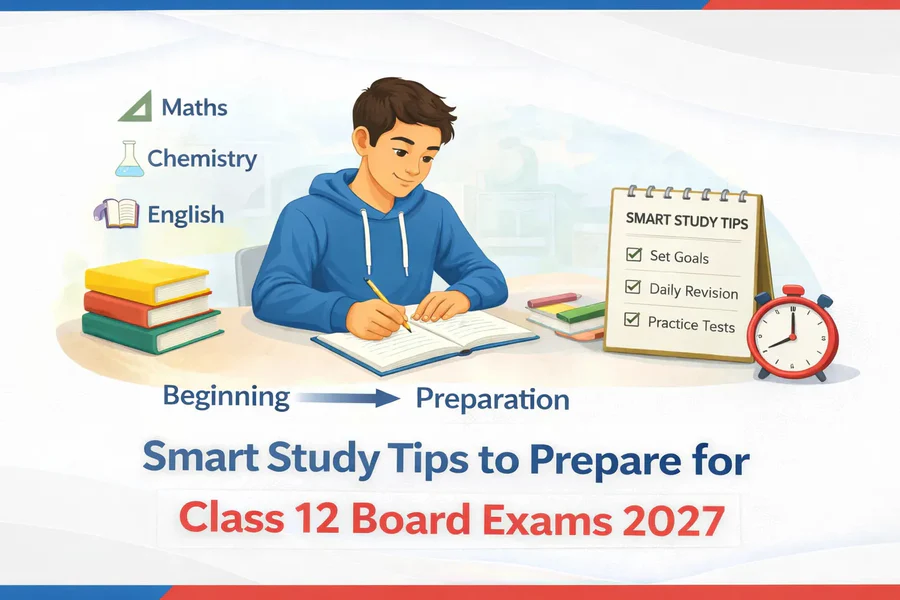
How Board Exam Toppers Prepare: 12 Proven Strategies That Help Students Score 95%+
Every year, thousands of students appear for board examinations, but only a small percentage achieve outstanding scores of 90% and above. Contrary to popular belief, toppers are not necessarily more intelligent—they simply follow smarter study techniques and maintain consistency throughout their preparation.
If you’re preparing for your Class 10 or Class 12 board exams, the strategies below can help you improve your performance and maximize your marks.
1. Write Answers Like You’re Appearing for the Actual Board Exam
One of the biggest differences between average students and toppers is writing practice.
Many students spend hours reading textbooks and watching lectures but write very few answers. Board exams test your ability to present answers clearly within a limited time.
Toppers regularly:
Solve complete question papers.
Write answers within the allotted time.
Use ruled sheets similar to board answer books.
Practice writing neatly and legibly.
The more you write, the more confident and faster you become during the actual examination.
2. Practice Previous Years’ Question Papers
Board exams often follow recurring patterns.
By solving previous years’ papers, students learn:
Most toppers solve at least 5–10 previous years’ papers before the examination.
3. Get Your Answer Sheets Checked by Teachers
Simply writing answers isn’t enough.
The real improvement happens when someone points out your mistakes.
Ask your school teachers or coaching faculty to review your answer sheets and provide feedback on:
Presentation
Content accuracy
Missing points
Grammar and language
Diagrams and labeling
Time management
Every corrected answer sheet becomes a valuable learning resource.
4. Study Model Answers Carefully
One of the fastest ways to improve your scores is by studying model answers prepared by experienced teachers or examination boards.
Pay attention to:
Introduction
Keywords
Headings
Point-wise presentation
Diagrams
Conclusion
Answer structure
Instead of memorizing entire answers, understand how high-scoring answers are written.
5. Focus on Presentation
Good presentation creates a positive impression on the examiner.
Toppers usually:
Write in neat handwriting.
Leave proper spacing.
Underline important keywords.
Use headings and subheadings.
Draw clean diagrams wherever required.
Number answers correctly.
Remember, presentation cannot replace knowledge—but it helps you earn every possible mark.
6. Create a Realistic Study Timetable
Successful students don’t study randomly.
They create a timetable that includes:
Daily revision
Writing practice
Mock tests
Difficult subjects
Short breaks
Consistency matters more than studying for long hours occasionally.
7. Revise Multiple Times
Reading a chapter once is rarely enough.
Toppers revise each chapter several times before the examination.
A simple revision cycle could be:
First revision within 24 hours
Second revision after one week
Third revision after one month
Final revision before the exam
This improves long-term memory and reduces last-minute stress.
8. Learn from Your Mistakes
Every mistake is an opportunity to improve.
Maintain a notebook where you record:
Review this notebook regularly to avoid repeating the same mistakes.
9. Attempt Full-Length Mock Tests
Mock tests help students become familiar with real exam conditions.
Practice by:
Sitting for the full duration of the exam.
Avoiding interruptions.
Using only permitted materials.
Checking whether you finish on time.
This builds speed, confidence, and stamina.
10. Don’t Ignore NCERT and Textbooks
Many toppers rely heavily on the prescribed textbooks, especially NCERT.
Before referring to additional books, ensure you thoroughly understand every chapter, example, diagram, and exercise from your school textbook.
11. Stay Healthy During Preparation
A healthy body supports a focused mind.
Remember to:
Avoid sacrificing sleep for late-night study sessions.
12. Stay Consistent Instead of Studying Only Before Exams
Perhaps the biggest habit shared by toppers is consistency.
Studying for 3–4 focused hours every day over several months is far more effective than trying to study 12 hours a day just before the examination.
Small daily improvements lead to outstanding results.
Common Mistakes Students Should Avoid
Only reading without writing practice.
Ignoring previous years’ question papers.
Not getting answers evaluated.
Memorizing without understanding concepts.
Skipping revision.
Leaving difficult chapters for the end.
Studying continuously without breaks.
Depending entirely on guess papers.
Final Thoughts
Scoring high marks in board examinations is not about studying endlessly—it’s about studying effectively.
Writing answers under exam conditions, getting regular feedback from teachers, analyzing model answers, solving previous years’ papers, and revising consistently are habits followed by almost every board topper.
Start implementing these strategies today. Even small improvements in your daily study routine can make a significant difference in your final board exam results.
Frequently Asked Questions (FAQs)
How many previous years’ papers should I solve before board exams?
Aim to solve at least 5 to 10 complete papers under timed conditions to become familiar with the exam pattern and improve speed.
Is writing practice really necessary for board exams?
Yes. Writing practice improves speed, presentation, confidence, and answer quality. It is one of the most effective ways to improve board exam scores.
Should I study model answers?
Yes. Model answers help you understand the structure, keywords, and presentation expected by examiners.
How can teachers help improve my board exam preparation?
Teachers can evaluate your answer sheets, identify mistakes, suggest improvements, and guide you on writing answers that fetch higher marks.
Is studying for long hours the secret to becoming a topper?
No. Consistency, smart planning, regular writing practice, revision, and effective time management are far more important than simply studying for long hours.