

Blog

Get Ready with Pen and Paper and Login to UTudaan Portal
Step 1

Select Topic and Start Exam
Step 2

Write Answers using pen and paper
Step 3

Complete Test & Take Photos of Answer Sheet
Step 4

Upload Answer Sheet PDF on Portal for Correction.
Step 5

End Exam and Your Answer Sheet is Submitted for Correction
Step 6

UT Teacher Correcting Your Answer Sheets
Step 7

View/Download Corrected Answer Sheet with Marks
Step 8

Improve Weak Topics by Using the Textbook, Corrected Answer Sheet, and Model Answers.
Step 9

www.UTudaan.com
Why Do Assertion & Reasoning Questions Feel Tricky?
Assertion & Reasoning Questions are an important part of the ICSE Class 10 Board Examination. Although they usually carry one mark, they test your conceptual understanding rather than memorization.
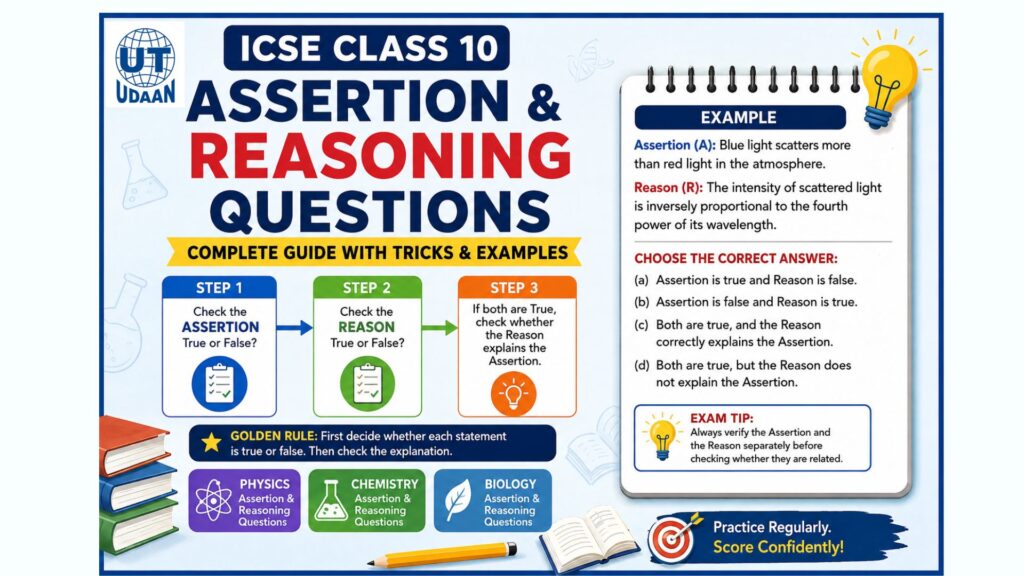
Many students lose marks because they immediately try to check whether the Reason explains the Assertion. Instead, follow this simple sequence:
- Check whether the Assertion is True or False.
- Check whether the Reason is True or False.
- If both are True, decide whether the Reason correctly explains the Assertion.
This simple approach makes One Mark Questions ICSE much easier to solve.
Understanding the ICSE Assertion & Reasoning Pattern
Example: Assertion (A): Blue light scatters more than red light in the atmosphere.
Reason (R) : The intensity of scattered light is inversely proportional to the fourth
Power of its wavelength
Choose the correct answer:
| Option | Meaning |
| (a) | Assertion is true and Reason is false. |
| (b) | Assertion is false and Reason is true. |
| (c) | Both are true, and the Reason correctly explains the Assertion. |
| (d) | Both are true, but the Reason does not explain the Assertion. |
How to Solve It
Step 1: Check the Assertion
Blue light has a shorter wavelength than red light, so it scatters more in the atmosphere.
→Assertion is True
Step 2: Check the Reason
Rayleigh scattering states that scattering intensity is inversely proportional to the fourth power of wavelength (1/λ⁴). → Reason is True
Step 3: Check the Explanation
The Reason correctly explains why blue light scatters more than red light. → Option (c)
Exam Tip: Always verify the Assertion and the Reason separately before checking whether they are related.
The 3-Step Formula
Step 1: Check whether the Assertion is True or False.
Step 2: Check whether the Reason is True or False.
Step 3: If both are true, check whether the Reason correctly explains the Assertion.
| Assertion | Reason | Explanation | Answer |
| True | True | Yes | (c) |
| True | True | No | (d) |
| True | False | — | (a) |
| False | True | — | (b) |
Golden Rule: First decide whether each statement is true or false. Then check the explanation.
This Strategy Works for Every Science Subject
Use the same approach for:
- ICSE Physics Assertion & Reasoning Questions
- ICSE Chemistry Assertion & Reasoning Questions
- ICSE Biology Assertion & Reasoning Questions
No matter the subject, the solving method remains the same.
Common Mistakes to Avoid
- Checking the explanation before verifying the statements.
- Reading only the Assertion.
- Ignoring words like always, never, only, and all.
- Assuming that two true statements always have a correct explanation.
Quick Tips to Score Full Marks
✔ Read the Assertion and Reason independently.
✔ Focus on concepts rather than keywords.
✔ Revise important laws, definitions, and formulae.
✔ Practice Assertion & Reasoning Questions after every chapter
For better ICSE Board Exam Preparation, solve chapter-wise and mock tests regularly.
 https://utudaan.com/icse-class-10-mock-tests/
Prepare Smarter with UT Udaan
Success in the board exam comes from consistent practice and strong concepts.
At UT Udaan, students get:
- Chapter-wise Practice Tests
- Board Pattern Mock Tests
- Detailed Performance Analysis
- Expert Guidance
- Regular Revision Tests
Whether you’re preparing ICSE Physics Assertion & Reasoning Questions, ICSE Chemistry Assertion & Reasoning Questions, or ICSE Biology Assertion & Reasoning Questions, UT Udaan helps you prepare with confidence. https://utudaan.com/icse-class-10-mock-tests/
Final Takeaway
Assertion & Reasoning Questions are among the easiest one-mark questions to score if you follow the correct method.
Assertion → Reason → Explanation → Choose the Correct Option
First determine whether the Assertion and Reason are individually true or false. Then check whether the Reason correctly explains the Assertion.
Practice consistently, strengthen your concepts, and you’ll score these marks with confidence.
Have more questions about the test series or board preparation?
Visit our FAQ page: https://utudaan.com/faqs