The wait is over! The Central Board of Secondary Education (CBSE) has officially released the Class 10 and Class 12 Board Exam Date Sheet 2027 on 6 November 2026.
For students preparing for their board examinations, this is an important moment. The timetable is now available, the examination dates are clear, and the final phase of preparation has officially begun.
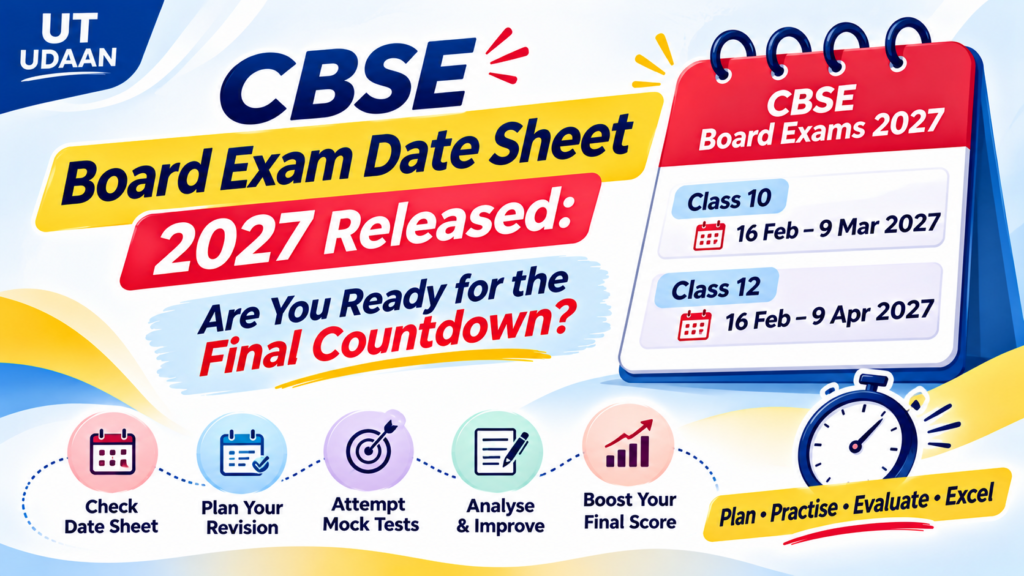
According to the announced schedule, both Class 10 and Class 12 board examinations will begin on 16 February 2027. Class 10 examinations are scheduled to conclude on 9 March 2027, while Class 12 examinations will conclude on 9 April 2027.
But receiving the date sheet is only the beginning. The bigger question is: Are you prepared to make the best use of the time remaining before your examinations?
Let’s understand the important dates and how you should plan your preparation from now onwards.
-
CBSE Board Exam Date Sheet 2027: Important Dates
Here are the key details students and parents should know.
| Particulars |
Details |
| Board |
Central Board of Secondary Education |
| Date sheet release date |
6 November 2026 |
| Examination year |
2027 |
| Class 10 exam start date |
16 February 2027 |
| Class 10 exam end date |
9 March 2027 |
| Class 12 exam start date |
16 February 2027 |
| Class 12 exam end date |
9 April 2027 |
The dates above provide an overview. Students must check the official PDF for their individual subject dates, examination duration and other instructions.
-
Where Can You Download the CBSE Date Sheet 2027?
Students should always download the timetable from the official CBSE website rather than relying on forwarded messages or unofficial social media posts.
Direct links:
Keep a copy of the official timetable and check the CBSE website for any subsequent updates or corrections.
-
Date Sheet Released! What Should You Do First?
Many students immediately start counting the number of days left for each subject. However, before changing your study routine, take some time to analyse the timetable.
Here are five things you should do.
- Highlight your subject-wise examination dates
Mark every examination date on a calendar. This will help you understand how much preparation time is available for each subject.
- Identify the gaps between examinations
Check which subjects have longer gaps and which subjects are scheduled close together. Plan your revision accordingly.
- Identify your difficult subjects
Do not give equal preparation time to every subject if your performance levels are different. Allocate additional practice time to subjects and chapters where you need improvement.
- Check your syllabus completion
Make a list of chapters that are completed, chapters that need revision and topics that require additional practice.
- Plan your mock tests
Do not wait until the final weeks to attempt full-length papers. Start practising under examination conditions and analyse your performance.
-
How to Plan Your Preparation After the Date Sheet Release
The date sheet gives you a fixed examination schedule. Now, your preparation should become more organised.
A practical preparation plan can be divided into three phases.
Phase 1: Strengthen Concepts and Revise Weak Chapters
Start by identifying topics that you find difficult.
- Revise important concepts from every subject.
- Practise chapter-wise questions.
- Solve numerical problems independently.
- Revise definitions, formulas, diagrams and important explanations.
- Practise competency-based and application-based questions.
Do not spend all your time rereading textbooks. Test whether you can answer questions without looking at your notes.
Phase 2: Practise Full-Length Mock Tests
Once your revision is progressing well, begin attempting complete mock papers.
While attempting a mock test:
- Follow the prescribed examination duration.
- Write answers using pen and paper.
- Avoid referring to textbooks or notes.
- Follow the actual question-paper format.
- Practise managing time across different sections.
- Complete the paper independently.
A full-length mock test helps you understand whether you can apply your knowledge under examination conditions.
Phase 3: Analyse Your Performance and Correct Mistakes
This phase is just as important as attempting the paper.
After every mock test, check:
- Which questions did you answer incorrectly?
- Where did you lose marks despite knowing the concept?
- Were your explanations complete?
- Did you show the required steps in numerical problems?
- Did you manage your time effectively?
- Were any questions left unanswered?
Maintain a mistake notebook and revise the errors before attempting your next paper.
-
How Should You Use the Gap Between Two Board Examinations?
The timetable may provide different gaps between your subjects. Students should use these days carefully.
However, remember that the gap between examinations is not meant for learning an entire subject from the beginning.
A practical approach is:
First part of the gap:
- Revise important chapters.
- Review concepts and formulas.
- Practise questions from difficult topics.
Middle part of the gap:
- Solve important questions.
- Practise selected sections of sample papers.
- Review diagrams, definitions and key points.
Final part of the gap:
- Revise your mistake notebook.
- Review important formulas and concepts.
- Check examination instructions.
- Avoid spending too much time on unfamiliar topics at the last moment.
Your preparation between two examinations should be based on the subject, syllabus coverage and your individual learning needs.
-
Why Is Solving Mock Tests Important Before CBSE Board Exams?
Knowing the syllabus and scoring well in an examination are two different things.
A student may understand a chapter but still lose marks because of incomplete answers, incorrect calculations, poor presentation or ineffective time management.
Mock tests help students identify these issues before the actual examination.
They provide opportunities to:
- Practise the latest question-paper pattern.
- Improve answer-writing speed.
- Understand different question formats.
- Practise case-based and competency-based questions.
- Develop time-management skills.
- Identify repeated mistakes.
- Improve confidence through regular written practice.
But there is one important point: Do not measure your preparation only by the number of mock tests you complete.
The real value of a mock test comes from understanding your mistakes after the test.
-
Don’t Just Check Your Mock-Test Marks. Analyse Your Corrected Answer Sheet!
Imagine you score 62 out of 80 in a Mathematics mock test.
You know your total marks, but do you know exactly why you lost the remaining 18 marks?
Perhaps you made calculation errors, missed important steps or misunderstood a question.
Similarly, in Science, you may lose marks because of missing scientific terminology, incomplete explanations or incorrectly labelled diagrams.
This is why checking your corrected answer sheet is important.
After every test, compare your answers with the model answers and evaluation feedback.
Pay attention to:
- Incorrect answers and missing steps.
- Important keywords and explanations.
- Diagrams and labelling.
- Presentation and answer structure.
- Repeated conceptual mistakes.
- Time-management issues.
Use the feedback to prepare differently for your next mock test.
-
How UTudaan Can Help You Prepare for CBSE Board Exams 2027
With the CBSE date sheet released, students need a structured approach to written practice and performance improvement.
UTudaan offers chapter-wise tests and full-syllabus mock tests to help students prepare for their board examinations.
The process is designed to go beyond simply attempting question papers.
How it works:
- Attempt the test: Students solve the test using pen and paper.
- Upload handwritten answer sheets: Submit completed answer sheets for evaluation.
- Manual evaluation: Subject experts evaluate the answers according to the relevant board pattern and marking scheme.
- Receive corrected answer sheets: Students can review their marks and understand where they lost marks.
- Study model answers and feedback: Compare responses and identify areas for improvement.
- Practise again: Apply the feedback in subsequent tests.
This approach helps students understand their actual performance and work on specific areas before the board examination.
UTudaan provides structured test practice for students across different classes and boards. Choose the test series according to your class and board:
For more details, visit UTudaan.
-
CBSE Board Exam 2027: Your Preparation Checklist
With the timetable now available, use this checklist to organise your preparation.
- I have downloaded the official CBSE date sheet.
- I have marked all my subject-wise examination dates.
- I know which subjects require additional revision.
- I have completed my syllabus or identified pending chapters.
- I am practising chapter-wise questions.
- I am attempting full-length mock tests.
- I am solving papers within the prescribed time.
- I am getting my handwritten answers evaluated.
- I am reviewing corrected answer sheets and model answers.
- I am maintaining a record of repeated mistakes.
- I am planning revision according to the examination timetable.
Conclusion: The Countdown Has Begun. Make Every Day Count!
The release of the CBSE Board Exam Date Sheet 2027 marks an important stage in your preparation journey.
You now have a clear examination schedule. The next step is to use your remaining preparation time wisely.
Do not simply count the days left for your examinations. Make sure every week includes revision, written practice, mock tests and proper evaluation.
Remember, completing the syllabus is important, but knowing how to write answers, manage examination time and avoid repeated mistakes is equally important.
Practise. Evaluate. Improve. Repeat.