The last 60 days before the CBSE and ICSE Class 10 Board Exams are not the time to study without a clear plan. By now, students should gradually shift their focus from completing chapters to preparing for the actual examination.
But here is an important question:
If you have completed your syllabus, can you actually solve an 80-mark question paper within the examination time, write answers according to the marking scheme and avoid losing marks on questions you already know?
This is where a planned mock-test strategy becomes essential.
Simply downloading sample papers or solving questions from textbooks is not enough. Students need to practise complete papers, get their answers evaluated, understand where they are losing marks and correct those mistakes before the board examination.
Here is a practical 60-day mock-test strategy for ICSE and CBSE Class 10 students.
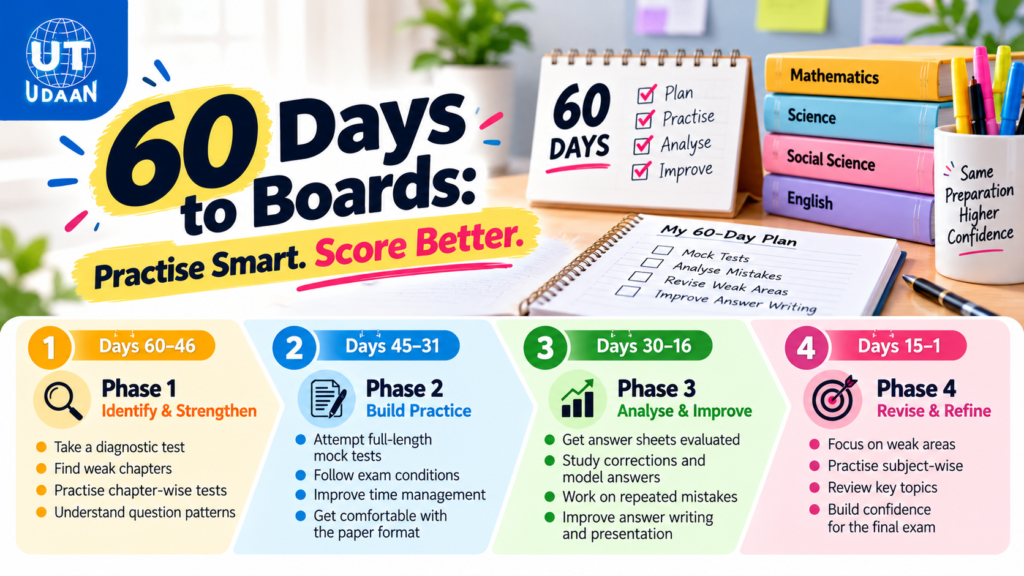
1. Days 60–46: Test Your Preparation before Increasing Mock-Test Frequency
The first step is to understand your actual preparation level.
Many students believe they are prepared because they can answer questions immediately after studying a chapter. However, solving the same questions independently, without notes and within a time limit, is a different challenge.
What should you do during this phase?
- Attempt one full-length diagnostic paper in each major subject, wherever time permits.
- Identify chapters in which you are unable to solve questions independently.
- Check whether you understand the different question formats in the latest syllabus and paper pattern.
- Identify whether your mistakes are conceptual, calculation-based or related to answer presentation.
- Revise weak chapters and attempt chapter-wise tests to check improvement.
Example:
A student may understand the chapter on Electricity but lose marks in numerical problems because of incorrect formula substitution or missing units.
Another student may know the Biology answer but lose marks because the explanation is incomplete or the required keywords are missing.
These are different problems and require different corrections.
Your target: Identify your weak areas and establish a performance baseline before moving to regular full-length mock tests.
2. Days 45–31: Start Full-Syllabus Mock Tests Under Examination Conditions
Once you have identified your weak areas, begin attempting complete board-pattern mock papers.
During this phase, students should practise solving the entire question paper in one sitting.
Do not pause the test to check formulas, refer to textbooks or search for answers.
Follow these examination conditions:
- Use a printed question paper.
- Write all answers on separate sheets using a pen.
- Follow the prescribed examination duration.
- Attempt questions according to the instructions and internal-choice pattern.
- Avoid using textbooks, notes or mobile phones.
- Check whether you have completed all sections within the allotted time.
What should you observe?
- Are you spending too much time on MCQs?
- Are you taking longer than expected to solve Mathematics problems?
- Are you writing lengthy answers for questions carrying fewer marks?
- Are you leaving long-answer questions incomplete?
- Are you able to attempt all compulsory questions?
The objective is to identify problems that may not become visible during ordinary chapter-wise practice.
3. Days 30–16: Follow the Attempt–Evaluation–Correction Cycle
This is one of the most important phases of your preparation.
By now, students should have attempted several full-length papers. Instead of simply attempting more papers, focus on improving the quality of each attempt.
Follow this three-step process after every mock test.
Step 1: Attempt the paper
Write the complete paper independently under examination conditions.
Step 2: Get the answer sheet evaluated
Get the handwritten answer sheet checked according to the relevant board pattern and marking scheme.
Step 3: Correct your mistakes
Study the corrections, compare your answers with model answers and identify why marks were deducted.
For example:
| Your Mistake |
What You Should Do
|
| Incorrect formula in Physics |
Revise the concept and solve similar numericals |
| Missing steps in Mathematics |
Practise complete step-by-step solutions |
| Incomplete Biology explanation |
Include essential keywords and points |
| Missing dates or examples in History |
Revise facts and practise structured answers |
| Incorrect chemical equation |
Practise balanced equations and required conditions |
| Poor time management |
Practise section-wise time allocation |
Do not move to the next paper without reviewing the previous paper.
Your target: Reduce repeated mistakes and improve your answer-writing quality with every test.
4. Days 15–7: Focus on Subject-Wise Mock-Test Practice
During the final 15 days, students should focus on the subjects and question types that need the most improvement.
A common mistake is following the same preparation method for every subject. Different subjects require different answer-writing skills.
Mathematics
- Practise complete papers within the prescribed time.
- Show all necessary calculation steps.
- Check formula application, signs, units and final answers.
- Review questions where the method was correct but the final answer was incorrect.
- Practise case-study and application-based questions.
Science
- Practise numerical problems, diagrams, definitions and reasoning questions.
- Use correct scientific terminology.
- Write chemical equations with appropriate conditions wherever required.
- Check whether explanations contain the essential points expected in the marking scheme.
- Practise assertion-reason and case-based questions according to the paper pattern.
Social Science
- Practise structured answers for 2-, 3- and 5-mark questions.
- Include relevant keywords, examples and dates.
- Practise map-based questions wherever prescribed.
- Avoid writing unnecessarily lengthy answers.
- Check whether every part of a question has been addressed.
English
- Practise reading comprehension within a fixed time.
- Follow the required formats for writing tasks.
- Improve grammar accuracy and sentence construction.
- Practise literature answers with relevant textual references and explanations.
- Check whether your answers directly address the question.
Your target: Improve subject-specific accuracy, presentation and time management rather than merely increasing the number of tests.
5. Days 6–1: Final Revision and Performance Review
The last few days should be used to consolidate your preparation.
Avoid attempting multiple full-length papers without enough time to analyse them.
Instead, review the feedback received from previous mock tests.
Focus on:
- Questions in which you repeatedly lost marks.
- Important formulas, definitions and diagrams.
- Frequently confused concepts.
- Common calculation and presentation errors.
- Topics that require quick revision.
- Examination instructions and question-paper format.
Review your corrected answer sheets and mistake notebook. Do not repeat the same mistakes during the final examination.
6. How Many Mock Tests Should You Attempt in the Last 60 Days?
The number of mock tests should depend on your preparation level and the time available for revision.
Here is a practical target for students:
|
Period
|
Suggested Mock-Test Plan |
Main Objective
|
| Days 60–46 |
Diagnostic paper and chapter-wise tests |
Identify weak areas |
| Days 45–31 |
1–2 full-length papers per subject, spread across the period |
Build examination practice |
| Days 30–16 |
Around 2 full-length papers per week across subjects |
Improve performance |
| Days 15–7 |
Selective subject-wise full-length papers |
Correct repeated mistakes |
| Days 6–1 |
Revision and selective question practice |
Final preparation |
This is a suggested framework, not a compulsory target. Students who have not completed their syllabus should first address important learning gaps before increasing their full-length mock-test frequency.
Remember: Ten mock tests without proper analysis may not be as useful as fewer tests followed by detailed evaluation and correction.
7. Five Things You Must Check in Every Corrected Mock-Test Paper
Your corrected answer sheet is one of the most useful resources available during the final 60 days.
Do not look only at the total marks. Check the following:
- Marks lost despite knowing the answer
Did you know the concept but fail to include an important point? Identify exactly what was missing.
- Step-wise marking
In subjects such as Mathematics and Physics, check whether you have shown the necessary steps, formulae, substitutions and calculations.
- Keywords and terminology
In Biology, Chemistry and Social Science, check whether you have used the appropriate technical terms and essential keywords.
- Answer length and presentation
Did you write too much for a short-answer question? Was your long answer sufficiently detailed? Were diagrams and steps presented clearly?
- Repeated mistakes
Compare your last two or three corrected papers. Are you making the same mistakes repeatedly? If yes, that topic or answer-writing skill needs immediate attention.
Maintain a simple record of your mistakes and revisit it before your next test.
8. How UTudaan’s Mock-Test Evaluation Can Help During These 60 Days
Attempting a mock test is only one part of examination preparation. Understanding how your answers are evaluated is equally important.
UTudaan provides a structured test-series approach for students preparing for ICSE and CBSE examinations.
The process involves:
- Attempt the test: Students solve chapter-wise tests or full-syllabus mock papers using pen and paper.
- Upload the answer sheet: Students submit their handwritten answer sheets for evaluation.
- Expert evaluation: Subject experts manually evaluate the answers according to the relevant board pattern and marking scheme.
- Review corrections: Students receive their corrected answer sheets and marks.
- Learn from model answers: Students can compare their responses with model answers and understand how to improve.
- Practise again: Students use the feedback to correct their mistakes in subsequent tests.
This process helps students understand not just how many marks they scored, but also where and why they lost marks.
UTudaan provides structured test practice for students across different classes and boards. Choose the test series according to your class and board:
Final Checklist: Are You Using Your Last 60 Days Effectively?
Before moving to your next mock test, check whether you are following these practices:
- I am attempting full-length papers under examination conditions.
- I am completing papers within the prescribed time.
- I am getting my handwritten answers evaluated.
- I am checking why marks were deducted.
- I am comparing my answers with model answers.
- I am maintaining a record of repeated mistakes.
- I am revising weak chapters between mock tests.
- I am improving my answer presentation and accuracy.
- I am reviewing my previous test performance before attempting another paper.
Conclusion: Don’t Just Attempt Mock Tests. Learn from Them.
The last 60 days before your board examinations should be about improving your examination performance.
Every mock test should help you answer three questions:
- What did I do correctly?
- Where did I lose marks?
- What will I improve in my next paper?
When students combine regular written practice with proper evaluation and correction, they get a clearer understanding of their preparation.
Practise. Evaluate. Improve. Repeat.