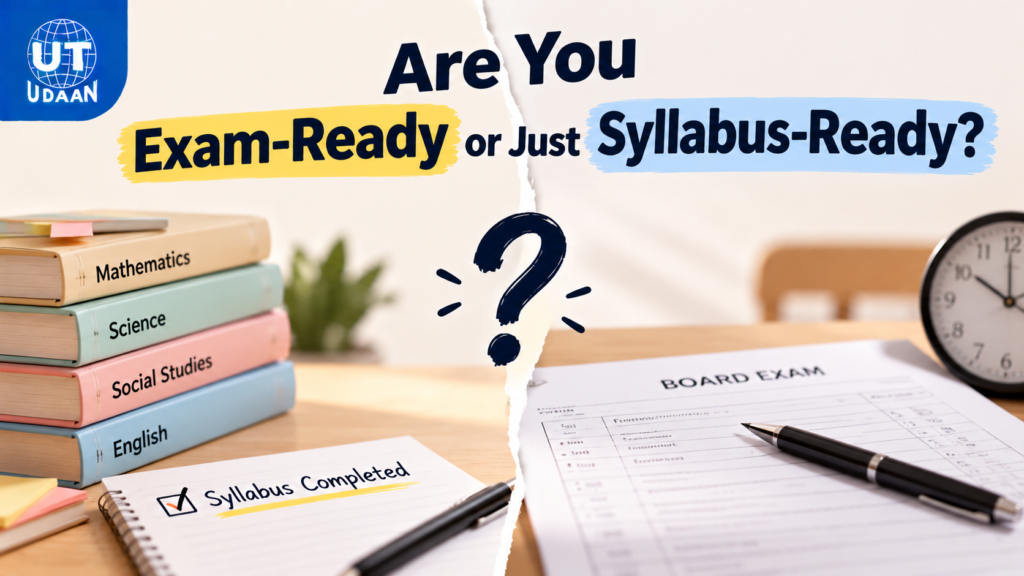
Have you completed your syllabus and feel confident about your board exams? That’s a great start! But completing the syllabus doesn’t always mean you’re ready to face the actual examination.
You may understand every chapter but still struggle to finish the paper on time, write complete answers or apply concepts to unfamiliar questions.
The real question is: Are you prepared to write the exam, or have you only prepared to study for it?
Let’s understand the difference and how mock tests can help you become exam-ready.
Syllabus-Ready vs Exam-Ready: What’s the Difference?
| Syllabus-Ready |
Exam-Ready
|
| Has completed the chapters |
Can answer questions independently |
| Has read and revised concepts |
Can apply concepts to different questions |
| Knows formulas and definitions |
Can use them correctly under time pressure |
| Has solved chapter-wise questions |
Can attempt a complete paper |
| Feels confident after studying |
Understands strengths and weaknesses through practice |
Completing the syllabus builds your foundation. Practising full-length papers helps you understand how well you can perform in examination conditions.
Can You Finish the Paper Within the Time Limit?
One common challenge student’s face is running out of time during examinations.
You might know the answers but spend too long on difficult questions, write excessively detailed responses or leave insufficient time for revision.
To improve your time management, practise complete papers within the prescribed examination duration.
During each test, check:
- Are you spending too long on particular questions?
- Can you complete every section?
- Do you leave time to review your answers?
- Can you maintain focus throughout the examination?
Regular timed practice helps you develop a strategy before the actual board exam.
Can You Write Answers That Earn Marks?
Reading a model answer and writing one yourself are two different things.
Board exams require you to present your knowledge clearly and accurately.
Ask yourself:
- Do I include the important keywords?
- Do I show the necessary steps in Mathematics?
- Can I explain scientific concepts correctly?
- Do I draw and label diagrams properly?
- Are my answers relevant to the questions asked?
Practising subjective questions helps you identify gaps between what you know and what you can communicate in writing.
Do You Know Where You Are Losing Marks?
Your marks tell you how you performed. Your corrected answer sheet helps explain why.
After every mock test, review your mistakes carefully.
| Common Problem |
What You Can Do
|
| Forgot important points |
Revise the concept and rewrite the answer |
| Made calculation errors |
Practise step-by-step working |
| Wrote incomplete explanations |
Compare your answer with model answers |
| Mismanaged time |
Attempt another timed paper |
| Repeated the same mistakes |
Maintain a mistake notebook |
Don’t move to the next test without learning from the previous one.
The aim is not just to take more tests. It is to improve with every test.
When Should You Start Full-Syllabus Mock Tests?
Don’t wait until the final few days before your board exams.
Once you have covered and revised a substantial portion of the syllabus, gradually introduce full-syllabus testing into your preparation. Increase the frequency as your preparation progresses and enough time remains to analyse and correct mistakes.
Follow this cycle: Revise → Attempt a Mock Test → Analyse Corrections → Improve Weak Areas → Test Again
This approach helps you identify problems early and gives you time to work on them.
A Quick Exam-Readiness Checklist
Before your next mock test, check how prepared you are.
- I can recall important concepts without looking at my notes.
- I can solve questions independently.
- I can write complete answers with relevant points.
- I can manage the examination time.
- I can attempt a full-length paper.
- I review corrected answer sheets and learn from my mistakes.
If some remain unchecked, don’t panic. Use them to decide what to practise next.
Get Exam-Ready with UTudaan
UTudaan helps students prepare through chapter-wise tests and board-pattern mock tests, giving them opportunities to practise questions under test conditions.
Students can use their test performance to identify weak concepts, improve answer writing, revise mistakes and practise again.
UTudaan provides structured test practice for students across different classes and boards. Choose the test series according to your class and board:
Final Takeaway
Being syllabus-ready means you have studied the topics. Being exam-ready means you can apply what you have learnt, write effective answers and manage your time under examination conditions.
So, ask yourself one question today:
Are you ready to write the paper, or have you only finished studying it?
Turn your preparation into performance with regular mock tests and careful evaluation.
UTudaan — Practise. Evaluate. Improve. Repeat.