Why Correct Answers Still Lose Marks in Class 10 Board Exams
A student may know the chapter, understand the concept and still lose marks in an examination.
Why?
Because knowing the answer and presenting the answer effectively are two different skills.
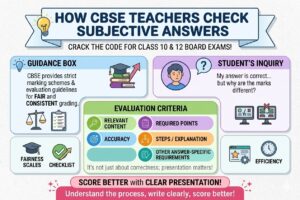
When teachers and examiners check answer sheets, they are not simply looking for whether a student has written something related to the question. The response is assessed against the requirements of the question, relevant content, accuracy, key points, steps, supporting evidence, diagrams where required and the applicable marking scheme.
CBSE’s published assessment resources, for example, emphasize clear value points, alternate acceptable answers and alignment between what a question asks and what the marking scheme expects. Its published marking guidance also states that correct answers should receive due marks even when a student’s expression differs from the suggested value points.
This means that good answer writing is not about writing more. It is about writing what the question requires, clearly and accurately.
Here are 10 common mistakes teachers notice while checking answer sheets—and how students can avoid them.
-
Not Answering Exactly What the Question Asks
This is one of the most common answer-writing mistakes.
Students sometimes know the topic extremely well but fail to answer the specific question asked.
For example, if a question asks: State two effects of deforestation.
A student may write a long paragraph explaining the causes of deforestation, its definition and methods of preventing it—but fail to clearly state two effects.
The knowledge may be correct, but the response is not sufficiently focused on the requirement of the question.
What teachers look for
Teachers generally need to identify the relevant answer points efficiently.
Better approach
Before writing, identify the command word:
- Define → Give the meaning.
- State → Give the required fact.
- Name → Write the specific term.
- Explain → Give the point with explanation.
- Give reasons → Provide the reason clearly.
- Differentiate → Give differences in an organised form.
- Calculate → Show the required working and answer.
- Compare → Present relevant similarities/differences.
- Justify → Give a claim supported by appropriate reasoning.
Remember: Answer the question—not the chapter.
-
Writing Long Answers Without Clear Key Points
More words do not automatically mean more marks.
A common mistake is writing one large paragraph containing several ideas without separating them.
Suppose a 4-mark question requires four distinct points. If all four are buried inside a lengthy paragraph, the answer may become difficult to follow.
Instead of this:
Writing one continuous paragraph containing multiple ideas, examples and explanations.
Try this:
- Point: Main idea
- Point: Supporting idea
- Point: Explanation/example
- Point: Relevant conclusion, where required
This makes the answer easier to read and helps ensure that the important content is visible.
The goal is not: Write more.
The goal is: Write relevant points clearly.
-
Missing Important Keywords and Subject Terminology
Students sometimes understand a concept but use vague language.
For example, in Science, writing:
“The object becomes bigger and the image is formed differently.”
is much weaker than stating the relevant scientific terms required by the question.
Similarly, in Geography, History, Biology, Chemistry or Physics, subject-specific terminology can communicate the exact concept more accurately.
Examples of useful terminology
Instead of: “The current becomes less.”
Use the appropriate scientific description relevant to the situation.
Instead of: “The plant loses water through its leaves.”
A precise answer may need the term: transpiration.
Instead of describing a biological structure vaguely, use its correct scientific name.
Important:
Do not insert keywords randomly.
The keyword must be conceptually correct and used in the correct context.
-
Not Showing Steps in Numerical Problems
This mistake is particularly important in Mathematics and Physics.
A student may know the correct formula and even arrive at the correct final answer—but skip the working.
For example:
Given: u = 10 m/s; v = 20 m/s; t = 5 s
Instead of simply writing: a = 2 m/s²
Show the relevant calculation:
Formula: a = (v-u)/t
Substitution: a = (20-10)/5
Answer: a = 2 m/s²
The exact marking requirements vary by question and marking scheme, so students should follow the expected method and show sufficient working.
CBSE’s assessment guidance specifically highlights detailed value points with steps when appropriate in marking schemes.
Why this matters
A clearly presented solution allows the evaluator to see:
- the formula,
- substitution,
- calculation,
- units,
- and final answer.
Rule: Don’t hide your method. Show your working.
-
Incorrect or Missing Units
This is a small mistake that can affect an otherwise correct numerical answer when the question requires a unit.
For example:
- Force → newton (N)
- Work → joule (J)
- Power → watt (W)
- Current → ampere (A)
- Resistance → ohm (Ω)
- Speed → m/s
- Density → appropriate unit based on the given system
A numerical value without its required unit may make the answer incomplete.
Before moving to the next question, ask: “Does my final answer require a unit?”
This one-second check can prevent avoidable errors.
-
Diagrams That Are Incomplete, Unlabelled or Incorrect
In subjects such as Biology, Physics and Geography, diagrams can communicate information that words alone cannot.
But simply drawing a diagram is not enough.
Common mistakes include:
- missing labels,
- incorrect labels,
- unclear arrows,
- unnecessary shading,
- disproportionate structures,
- missing important parts,
- drawing the wrong diagram,
- or failing to draw a diagram when the question specifically requires one.
A good examination diagram should be: Clear + Relevant + correctly labelled + Easy to interpret
For Biology, for example, students should practise diagrams repeatedly rather than trying to reproduce them from memory for the first time during the examination.
Remember: A diagram is part of the answer—not decoration.
-
Ignoring the Difference Between “Define,” “Explain,”“Give Reason” and “Differentiate”
Command words matter. Consider these questions:
Define: “What is refraction?”
Explain: “Explain why a pencil appears bent when partially immersed in water.”
Give reason: “Give a reason why …”
Differentiate: “Differentiate between …”
These questions may concern the same chapter, but they require different forms of response.
A useful examination habit
Underline or mentally identify the command word before answering.
| Question word |
What your answer should generally do |
| Define |
Give the precise meaning |
| State |
Give the required fact |
| Name |
Provide the specific term |
| Explain |
Give the idea and its explanation |
| Give reason |
Provide the relevant reason |
| Differentiate |
Present clear differences |
| Calculate |
Show appropriate working |
| Justify |
Support the answer with reasoning |
| Describe |
Present relevant features/details |
The exact requirements always depend on the question.
Remember:
The command word tells you how to frame the answer.
-
Making Avoidable Presentation Mistakes
Presentation does not mean decorating an answer sheet.
Students do not need fancy borders, excessive colours or artistic handwriting.
What matters is clarity and readability.
Common presentation problems include:
- extremely small handwriting,
- overcrowded lines,
- unclear corrections,
- answers running together,
- no separation between sub-parts,
- poorly positioned diagrams,
- illegible mathematical calculations,
- and excessive cutting and overwriting.
A simple structure works well:
Q.3 (a) Answer…
Q.3 (b) Answer…
For longer answers, use short paragraphs or numbered points where appropriate.
Think like a reader:
If someone had to find the four important points in your answer quickly, could they?
If yes, your presentation is doing its job.
-
Writing Irrelevant Information
This is a surprisingly common problem.
Students sometimes believe:
“If I write everything I know about the topic, I will get more marks.”
Not necessarily.
If a question asks for two reasons, giving a page of unrelated information does not make the answer stronger.
Irrelevant content can actually make the main answer harder to identify.
Example: Question: Give two advantages of a particular method.
Weak approach: Definition → history → unrelated example → three disadvantages → advantages → conclusion.
Better approach:
Advantage 1: Relevant explanation.
Advantage 2: Relevant explanation.
Golden rule: Relevant content beats extra content.
-
Not Checking the Answer Sheet Before Submission
Many marks are lost not because students do not know the answer—but because they fail to check their work.
The final few minutes can be extremely valuable.
Check for:
- Unattempted questions
- Missing sub-parts
- Incorrect question numbers
- Units in numerical answers
- Formula mistakes
- Calculation errors
- Diagram labels
- Spelling of important technical terms
- Required headings/points
- Pages or continuation sheets, where applicable
- Whether the final answer is clearly identifiable
Do not spend the entire examination writing until the final second.
Try to reserve some time for checking.
What Teachers Notice First While Checking an Answer Sheet
When an answer sheet is evaluated, the examiner’s job is not to judge whether the student has “written a lot.”
The response must be assessed against the requirements of the question and the applicable marking guidance.
CBSE’s published marking guidance states that evaluators should follow the marking scheme rather than their own interpretation, while also allowing correct expressions and innovative/correct responses to receive due marks.
This gives students an important lesson:
Don’t try to impress the examiner with length.
Instead, make your answer: Correct. Relevant. Complete. Clear.
A Teacher’s Checklist for a Strong Board-Exam Answer
Before moving to the next question, develop the habit of checking these five things:
- Did I answer the exact question?
If the question asks for causes, did I give causes?
If it asks for effects, did I give effects?
If it asks for reasons, did I give reasons?
- Did I include the required points?
For a multi-mark question, make sure your response contains the necessary number and quality of relevant points.
- Did I use correct subject terminology?
Use precise scientific, mathematical, geographical, historical or economic terms wherever appropriate.
- Did I show sufficient working?
For numerical questions, show the relevant formula, substitution and calculation wherever required.
- Can the examiner easily understand my answer?
Your answer should be readable and logically organised.
The Difference Between a Student Who Knows and a Student Who Scores
Two students may know the same concept. But their answer sheets may look very different.
|
Student A
|
Student B
|
- Writes everything in one paragraph
|
- Reads the question carefully
|
|
|
- Identifies what is being asked
|
|
|
|
|
|
- Uses appropriate terminology
|
|
|
|
- Leaves diagrams unlabelled
|
|
|
|
- Organises answers clearly
|
| |
- Checks the paper before submission
|
The difference is not necessarily how much they studied.
It can also be how effectively they communicate what they know.
How to Improve Your Answer Writing Before Board Exams
Answer writing is a skill. It improves through practice.
Step 1: Practise chapter-wise questions
Do not wait for the full syllabus to be completed.
After finishing a chapter, solve questions based on that chapter.
Step 2: Compare your answer with the marking scheme
Look for:
- missing points,
- incorrect terminology,
- incomplete explanations,
- calculation errors,
- missing units,
- and unnecessary information.
CBSE provides sample question papers and marking schemes for Class X subjects through its academic resources, making these useful references for understanding question patterns and expected responses.
Step 3: Practise timed writing
Knowing an answer at home is different from writing it under examination conditions.
Practise completing questions within realistic time limits.
Step 4: Analyse your mistakes
Don’t simply count your marks.
Ask:
Why did I lose this mark? Was it because of:
- Knowledge?
- Interpretation?
- Incomplete answer?
- Calculation?
- Presentation?
- Terminology?
- Time management?
This turns every test into a learning opportunity.
Practise With UT Udaan
Regular practice is one of the best ways to improve board-exam answer writing.
UT Udaan helps students prepare through structured practice, including chapter-wise tests and board-pattern mock tests.
Students can use their test performance to identify weak concepts, improve answer presentation, practise different question formats and build confidence before the board examination.
Practise. Analyse. Improve. Repeat.
Because the goal is not simply to complete a test.
The goal is to learn how to write an answer that communicates your knowledge clearly and effectively.
Final Takeaway: Write for the Marks, Not Just for the Page
A board examination is not a competition to see who can fill the most pages.
It is an opportunity to demonstrate what you know accurately, clearly and relevantly.
Avoid these 10 common mistakes:
- Not answering exactly what the question asks
- Writing long answers without clear key points
- Missing important subject terminology
- Not showing sufficient numerical working
- Forgetting units
- Drawing incomplete or unlabelled diagrams
- Ignoring command words
- Making avoidable presentation mistakes
- Including irrelevant information
- Failing to check the answer sheet
The smartest answer-writing strategy is simple:
- Understand the question.
- Identify what it demands.
- Write the relevant points.
- Use precise terminology.
- Show your working.
- Present clearly.
- Check before submitting.
Don’t just know the answer. Learn how to present it.
Write Smart. Practise Consistently. Score Confidently.
UT Udaan — Write Smarter. Score Better. Be the BEST!
FAQs: UT Udaan FAQs
Frequently Asked Questions
How do teachers check Class 10 board exam answer sheets?
Teachers/evaluators assess answers according to the applicable examination instructions and marking scheme. The focus is on whether the response satisfies the question’s requirements and contains the relevant, correct content. CBSE’s published guidance also discusses value points, alternate acceptable answers and evaluation consistency.
Can a student lose marks even if the main concept is correct?
Yes. A response can still be incomplete if it does not adequately address what the question asks—for example, missing required parts, calculations, explanations, labels or other necessary elements. However, students should not assume that their wording must exactly reproduce a model answer; CBSE’s published guidance explicitly recognizes correct expression and acceptable responses beyond the suggested value points.
Does writing more pages guarantee more marks?
No. Marks are based on the relevant requirements of the question, not simply on the number of pages written.
Should students underline keywords?
Underlining can improve readability when used selectively, but it should not replace correct content. Students should focus first on accuracy, relevance and completeness.
Is handwriting important in board examinations?
Readable handwriting is important because the evaluator must be able to understand the response. Students should aim for clear, legible writing rather than decorative presentation.
Should students write answers in points or paragraphs?
It depends on the question. Use the format that communicates the answer most clearly. Lists or numbered points can be useful when a question asks for several distinct points, while explanations may be better presented in sentences or short paragraphs.
How can students improve answer writing?
Regularly practise board-pattern questions, compare responses with the applicable marking scheme or model guidance, identify why marks were lost and repeat the question after correcting the mistake.