Many Class 10 students have the same question after their board examination:
“If my answer is correct, how does the teacher decide how many marks I will get?”
Students often imagine that examiners simply read an answer and decide whether it “looks correct.” In reality, CBSE Class 10 answer sheets are evaluated according to established marking schemes and evaluation guidelines.
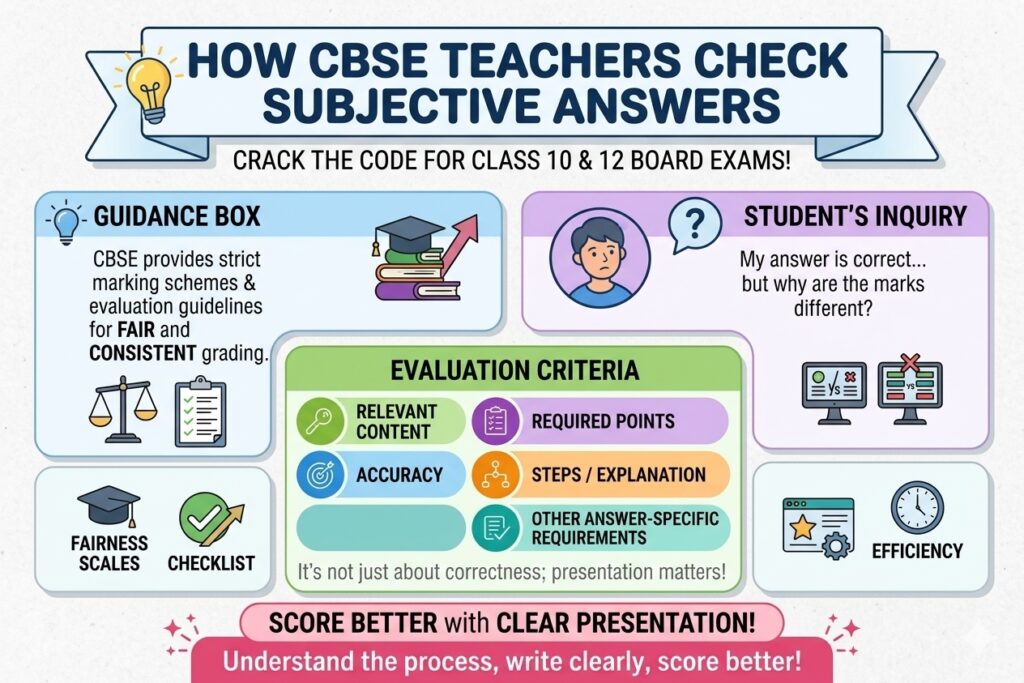
For subjective questions, examiners look at the relevant content, required points, accuracy, steps, explanation and other answer-specific requirements while awarding marks.
Understanding this process can help students improve one important skill: writing answers in a way that clearly communicates what they know.
How Are CBSE Class 10 Subjective Answers Evaluated?
For board examinations, CBSE provides marking schemes for subjects along with sample question papers. These marking schemes help examiners follow a consistent approach while evaluating answers.
The marking scheme generally contains value points or expected elements of an answer. However, it is not necessarily a single model answer that students must reproduce word-for-word.
CBSE’s evaluation instructions state that marking schemes contain suggested value points and that students may use their own expression when the answer is correct.
This means:
You do not always need to write the exact textbook sentence to earn marks. You need to communicate the correct answer clearly and accurately.
What Do Teachers Look for in a Subjective Answer?
When evaluating a subjective answer, an examiner may consider several aspects depending on the question and subject.
- Correct Content
The first and most important factor is whether the answer contains the correct information.
For example, if a question asks: “State Newton’s First Law of Motion.”
A student should clearly state the law rather than writing a general explanation about force and motion.
If the question asks for a definition, the definition should be accurate.
If it asks for reasons, the relevant reasons should be mentioned.
- Important Value Points
A question carrying several marks may require several distinct points.
Suppose a question carries 3 marks and expects three relevant points.
A student who writes only one correct point may not automatically receive all three marks simply because the general idea is correct.
This is why students should pay attention to words such as:
- State
- Define
- Explain
- Give reasons
- Differentiate
- Mention any two
- Describe
- Justify
- Calculate
- Prove
- Compare
The command word tells you what kind of response is required.
Does the Examiner Expect the Exact Textbook Language? No.
Students do not generally need to reproduce textbook sentences word-for-word.
CBSE’s published marking guidance specifically notes that the marking scheme contains suggested value points and that correct answers expressed in the student’s own words can receive marks.
For example:
Question: Why does the sky appear blue?
A student does not necessarily need to reproduce the exact wording from the textbook.
What matters is that the answer correctly explains the relevant concept, such as the scattering of shorter wavelengths of visible light.
Therefore: Understand → Recall → Explain clearly
is more useful than trying to memorise every sentence exactly as it appears in the textbook.
How Are 2-Mark, 3-Mark and 5-Mark Answers Checked?
The number of marks attached to a question generally indicates the expected depth of the response, but students should always follow the specific requirements of the question.
1-Mark Questions
A 1-mark subjective question usually requires a specific fact, definition, term, formula, identification or short response.
Avoid writing a long paragraph when one precise statement is enough.
2-Mark Questions
A 2-mark question may require:
- Two relevant points
- A definition with an explanation
- A short calculation
- Two differences
- A reason with an appropriate explanation
3-Mark Questions
A 3-mark question may require three important points, or a sequence of steps/explanation depending on the subject.
For example:
Question: Explain three effects of a particular geographical or historical development.
The answer should make the three relevant effects easy to identify.
4- or 5-Mark Questions
Long-answer questions require greater detail.
Depending on the subject, the answer may involve:
- Multiple value points
- Step-by-step calculation
- Explanation
- Examples
- Diagram
- Formula and substitution
- Conclusion
- Comparison
The key is not simply writing more. The key is writing the required content.
Does Presentation Affect Marks?
Students often ask:
“Will I lose marks if my handwriting isn’t beautiful?”
Good handwriting by itself does not earn marks.
However, an answer should be legible and easy to evaluate.
An examiner needs to identify your points and understand your answer without unnecessary difficulty.
Therefore, students should focus on:
- Clear handwriting
- Proper spacing
- Correct question numbering
- Logical sequence
- Appropriate diagrams
- Labelling diagrams where required
- Showing important steps
- Avoiding unnecessary overwriting
- Keeping answers relevant
Remember:
Good presentation does not replace correct content.
But clear presentation can make your correct content easier to identify.
Do Teachers Give Marks for Steps in Mathematics and Science?
For questions involving calculations, derivations or multiple steps, students should show their working wherever appropriate.
For example: Given → Formula → Substitution → Calculation → Answer with unit
is much clearer than writing only the final number.
Similarly, in Science, if a numerical problem requires a formula and calculation, students should show the relevant working.
A final answer without the necessary working may make it difficult to demonstrate how the result was obtained, depending on the question and marking requirements.
What Happens If an Answer Is Partly Correct?
This is one of the most important things students should understand.
A subjective answer does not always have to be completely right or completely wrong.
If a question has multiple required parts or value points, the examiner can award marks for the relevant correct portions according to the marking scheme.
CBSE evaluation instructions also specify that marks should be awarded for different parts of a question and then totalled appropriately.
For example:
3-mark question
A student’s response contains:
- Point 1 — Correct
- Point 2 — Correct
- Point 3 — Incorrect
The evaluation will depend on the question and marking scheme, but the presence of an incorrect third point does not automatically mean the two correct value points disappear.
This is why students should attempt every question carefully rather than assuming that one mistake makes the entire answer worthless.
What If Your Answer Is Different from the Marking Scheme?
This is a common student concern.
Suppose the marking scheme contains a particular wording, but a student explains the same concept using different words.
That does not automatically make the answer wrong.
CBSE’s published marking instructions say that marking schemes provide suggested value points and are guidelines rather than necessarily complete answers. They also state that correct expression by students should receive due marks.
For competency-based questions, CBSE guidance also instructs evaluators to consider a student’s response even when it differs from the marking scheme, provided the required competency has been correctly demonstrated.
Therefore:
Don’t try to copy the marking scheme. Understand the concept and express it correctly.
Do Examiners Check Every Answer?
Yes. CBSE has procedures intended to ensure that answer books are evaluated systematically.
CBSE has stated that teachers involved in evaluation receive training, evaluation is conducted under supervision, evaluators discuss the marking scheme before evaluation, and quality checks are carried out during the process.
CBSE’s evaluation instructions also include checks intended to prevent issues such as:
- Unassisted answers
- Incorrect totaling
- Incorrect transfer of marks
- Marks being awarded incorrectly
- Other evaluation errors
This demonstrates why students should focus on answer quality rather than trying to predict who will check their paper.
Why Do Students Lose Marks Even When They Know the Answer?
Knowing the concept and communicating it effectively are two different skills.
Students can lose marks because they:
❌ Write a vague answer : The examiner may not be able to identify the required point.
❌ Miss one part of the question: For example, the question asks for two reasons, but the student gives only one.
❌ Do not show necessary steps: This is particularly important in numerical and mathematical questions.
❌ Give irrelevant information: A long answer does not compensate for missing the required point.
❌ Forget units: In numerical questions, the final answer should include the appropriate unit wherever required.
❌ Draw incomplete diagrams: A diagram-based question may require proper labelling or specific features.
❌ Misread the command word: “Define”, “Explain”, “Differentiate”, and “Justify” do not require exactly the same type of response.
How Should You Write Answers to Make Evaluation Easier?
Use this simple approach: READ → THINK → STRUCTURE → WRITE → CHECK
READ: Read the complete question carefully.
THINK: Identify exactly what the question is asking.
STRUCTURE: Decide whether you need:
- A definition
- Points
- Explanation
- Formula
- Calculation
- Diagram
- Comparison
- Example
WRITE: Present the answer clearly and directly.
CHECK: Before moving ahead, check whether you have answered every part of the question.
Example: Weak Answer vs Better Answer
Question: Why does the sky appear blue?
❌ Weak approach:
“The sky is blue because of the atmosphere and sunlight.”
This is too vague and does not clearly explain the required scientific concept.
✅ Better approach:
Explain the relevant phenomenon of scattering of sunlight by particles in the atmosphere, with the appropriate explanation of why shorter wavelengths are scattered more strongly.
The second response demonstrates the concept more clearly and gives the examiner identifiable content to evaluate.
Subject-Wise Answer-Writing Tips for Class 10:
Mathematics
Focus on: Formula → Substitution → Steps → Final Answer
Do not hide your working.
Science
Focus on: Concept → Explanation → Formula/Equation → Diagram/Example where required
Use correct scientific terminology.
Social Science
Focus on: Relevant point → Explanation → Supporting detail/example
For long answers, separate distinct points clearly.
English
Focus on: Understanding the question → Relevant content → Organisation → Language accuracy
Follow the specific requirements of the question.
Hindi and Other Languages
Focus on: Content → Relevance → Language → Organisation → Required format
Always follow the question-specific instructions.
Do You Need to Write Very Long Answers to Get More Marks? No.
One of the biggest misconceptions about board examinations is:
“More pages = more marks.”
Marks are awarded for the required content and quality of the response, not simply for the number of lines written.
A precise 3-mark answer containing the required points can be more effective than a long answer filled with repetition.
The goal should be: Relevant + Accurate + Complete + Well Presented
—not unnecessarily lengthy.
The Smartest Way to Prepare for Subjective Board Questions
Students should not wait until the board examination to learn answer writing.
During preparation, practise writing answers under realistic conditions.
After completing a chapter:
Step 1: Learn the concept: Don’t memorise without understanding.
Step 2: Solve different question types: Practise:
- Short-answer questions
- Long-answer questions
- Case-based questions
- Competency-based questions
- Application-based questions
- Numericals
- Diagram-based questions
Step 3: Check your answer: Ask: Did I answer exactly what was asked?
Step 4: Improve your presentation: Look for:
- Missing points
- Incorrect terminology
- Missing units
- Missing steps
- Poor diagrams
- Unclear explanations
Step 5: Repeat: Consistent practice gradually improves both accuracy and answer-writing confidence.
How Marking Schemes Can Help Students
CBSE publishes Sample Question Papers and Marking Schemes for Class X subjects. These resources help students understand the question-paper design and expected approach to answers.
Students can use them not simply to check answers after a test, but to understand:
- What different questions are asking
- How marks are distributed
- What important points an answer may require
- How competency-based questions are approached
- How to improve their own answer writing
CBSE Class 10 Sample Question Papers & Marking Schemes
Practise Board-Pattern Questions with UT Udaan
UT Udaan helps students prepare through chapter-wise tests and board-pattern mock tests, giving them opportunities to practise questions under test conditions.
Students can use their test performance to identify weak concepts, improve answer writing, revise mistakes and practise again.
UT Udaan provides structured test practice for students across different classes and boards. Choose the test series according to your class and board:
Practise → Analyse → Improve → Practise Again
That is how students can make their preparation more effective. UT Udaan Class 10 Test Series
Final Takeaway: Write for the Examiner to Understand
CBSE Class 10 subjective answers are not evaluated simply on the basis of how long they are or how closely they resemble textbook sentences.
The evaluation process uses marking schemes, value points and established guidelines to support consistent assessment.
So, when you sit for your board examination, remember:
Don’t just write what you know. Write what the question asks.
- Understand the question.
- Recall the concept.
- Include the required points.
- Show your steps where necessary.
- Use correct terminology.
- Present your answer clearly.
- And practise regularly.
Write Smarter. Score Better. Be the BEST!