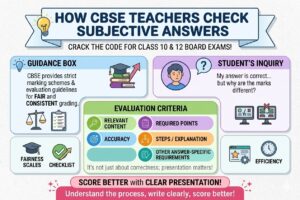
Students often feel confused after an examination when they know they wrote the correct answer but still did not receive full marks.
The problem is that knowing the answer and presenting the answer in a way that earns full marks are two different skills.
In board examinations, marks are awarded based on the content, accuracy, relevance, key points, steps, presentation and requirements of the question. A student may understand the concept correctly but lose marks because an important point was missing, the answer was unclear, a diagram was not labelled, or the required steps were not shown.
So, why do students lose marks even when their answer is correct?
1. The Answer Does Not Directly Address the Question
Sometimes students know the topic very well but write everything they remember instead of answering exactly what has been asked.
For example, if a question asks:
“State two reasons for the occurrence of an echo.”
A student may write a long explanation about sound, reflection and reverberation but fail to clearly mention the two required conditions.
How to Avoid This Mistake
Before answering, identify the command word:
- Define → Give a precise definition.
- State → Give the required fact or points.
- Explain → Give the reason or working clearly.
- Differentiate → Write differences in a suitable format.
- Calculate → Show the formula, substitution and answer.
- Give reasons → Write the specific reason asked for.
- Describe → Explain the process or features in an organised manner.
Answer what is asked—not everything you know.
2. Important Keywords Are Missing
A student’s explanation may be conceptually correct but may not contain the key terms expected in the answer.
For example: Question: What is photosynthesis?
A student might write: “Plants prepare their food using sunlight.”
The idea is correct, but a complete definition should include important terms such as green plants, carbon dioxide, water, sunlight and chlorophyll, depending on the expected marking points.
Remember: Correct idea + required keywords = stronger answer
Students should learn important definitions, laws, principles and scientific terms accurately rather than relying only on approximate wording.
3. The Student Does Not Show the Required Steps
This is particularly important in Mathematics and numerical-based subjects.
Suppose a student writes the correct final answer but does not show the calculation.
Even if the final value is correct, the answer may not demonstrate how it was obtained.
For numerical questions, develop the habit of writing:
Given → Formula → Substitution → Calculation → Final Answer with Unit
For example:
Formula: V = IR
Substitution: V = 2 × 5
Answer: V = 10 V
Showing your working makes your solution easier to follow and reduces the possibility of losing marks for incomplete presentation.
4. Diagrams Are Correct but Not Properly Labelled
In subjects such as Biology, Physics and Geography, diagrams can carry important marks.
A student may draw the correct diagram but lose marks because:
- Labels are missing.
- Labels are incorrect.
- Important parts are not shown.
- Lines are unclear.
- The diagram is too small.
- Arrows are incorrectly placed.
- The diagram is not neat enough to interpret easily.
A Good Diagram Should Be : Neat + Clear + Correct + Properly Labelled
Do not treat diagrams as decoration. When a question asks for a diagram, make sure every required part is clearly represented.
5. The Answer Is Too Short for the Marks Allocated
A common mistake is assuming:
“My answer is correct, so one sentence should be enough.”
Not always.
A 1-mark question and a 3-mark question may require very different levels of detail.
For a 3-mark question, there may be three separate marking points. If you provide only one correct point, you may receive only part of the available marks.
A Useful Habit
Look at the marks allotted and ask:
“How many points or parts does this answer require?”
For example:
3 marks → potentially three key points, steps, reasons or components, depending on the question.
The exact marking scheme can vary, so marks should be used as a guide rather than a rigid formula.
6. The Student Writes Everything in One Long Paragraph
A correct answer can become difficult to evaluate when several points are hidden inside a large paragraph.
Compare
Long paragraph:
Several different reasons are written continuously without clear separation.
Organised answer:
- First point
- Second point
- Third point
The second format makes the important information easier to identify.
Use
- Bullet points
- Numbered points
- Subheadings
- Tables for comparisons
- Equations for calculations
- Labelled diagrams where required
Good presentation does not replace correct content—but it helps communicate correct content clearly.
7. The Student Does Not Follow the Required Format
Some questions require a specific presentation.
For example, when asked to differentiate between two concepts, a table can make the answer much clearer.
Difference between Two Concepts
|
Basis
|
Concept A |
Concept B
|
| Definition |
|
|
| Feature |
|
|
| Example |
|
|
Similarly, a flowchart may be appropriate for a process, while a labelled diagram may be required for a structure.
Always check what the question is asking you to present.
8. Units Are Missing in Numerical Answers
A numerical answer may be mathematically correct but incomplete if the unit is omitted when a unit is required.
For example:
Incorrect presentation:
Speed = 20
Better: Speed = 20 m/s
Develop the habit of checking: Number + Correct Unit
before moving to the next question.
9. The Student Does Not Make the Final Answer Clear
In lengthy numerical or explanatory answers, the final result should be easy to identify.
For calculations, you can clearly write:
Therefore, speed = 20 m/s.
For theory answers, important terms can be made visually clear through proper structuring rather than excessive decoration.
The goal is clarity, not over-formatting.
10. Careless Errors Can Make a Correct Concept Look Incorrect
A student may know the concept but make a small error while writing:
- Wrong sign
- Incorrect unit
- Spelling of a scientific term
- Wrong equation
- Incorrect label
- Missing decimal
- Incorrect conversion
- Copying a number incorrectly
These errors can affect the final answer even when the student understood the question.
The Solution
Reserve a few minutes at the end of the examination for checking.
Do not simply reread the paper.
Instead, check: Formula → Calculation → Unit → Labels → Keywords → Question Numbers
Correct Answer ≠ Automatically Full Marks
This is one of the most important lessons students should understand.
A student may have:
Concept knowledge ✅
Correct idea ✅
Correct final answer ✅
but still lose marks because:
Required point missing ❌
Keyword missing ❌
Steps not shown ❌
Diagram not labelled ❌
Unit missing ❌
Answer does not match the question ❌
That is why answer-writing practice is as important as studying the chapter.
How Can Students Stop Losing Marks?
Before submitting your answer sheet, develop a simple FULL-MARKS CHECK.
F – Focus on the Question: Did I answer exactly what was asked?
U – Use Keywords: Did I include the important terms?
L – Look at Marks : Have I provided enough points or steps?
L – Label Diagrams: Are all required labels clear and correct?
M – Mention Units: Have I included the correct unit wherever required?
A – Arrange the Answer: Is my answer clear and properly structured?
R – Recheck Calculations: Have I checked formulas, signs and arithmetic?
K – Keep the Final Answer Clear: Can the examiner easily identify my final answer?
S – Scan Before Submitting: Use the last few minutes to check for avoidable mistakes.
Practise Answer Writing, Not Just Question Solving
Many students practise by reading solutions and thinking:
“I know this answer.”
But knowing an answer is different from writing it under examination conditions.
Regular practice helps students learn how to:
- Identify what the question is asking
- Select the relevant information
- Use appropriate keywords
- Write according to marks
- Show proper steps
- Draw and label diagrams
- Manage time
- Avoid careless mistakes
- Improve answer presentation
This is why board-pattern practice and mock tests are an important part of exam preparation.
Practise. Analyse. Improve. Repeat.
After every test, don’t look only at your total marks.
Ask:
“Where did I lose marks?”
Was it because of:
- Lack of knowledge?
- Incomplete answer?
- Missing keyword?
- Calculation error?
- Poor presentation?
- Missing diagram or label?
- Incorrect unit?
- Time management?
Once you identify the reason, you can work specifically on that weakness.
Practise with UT Udaan
UT Udaan helps students prepare through chapter-wise tests and board-pattern mock tests, giving them opportunities to practise questions under test conditions.
Students can use their test performance to identify weak concepts, improve answer writing, revise mistakes and practise again.
UT Udaan provides structured test practice for students across different classes and boards. Choose the test series according to your class and board:
Final Takeaway
A correct answer is only the starting point.
To score well in board examinations, students need to learn how to present what they know clearly, accurately and according to the question’s requirements.
Don’t just ask: “Do I know the answer?”
Also ask:
“Can I write this answer in a way that clearly communicates every required marking point?”
Learn smart. Practise consistently. Revise strategically. Score confidently.
Write Smarter. Score Better. Be the BEST!