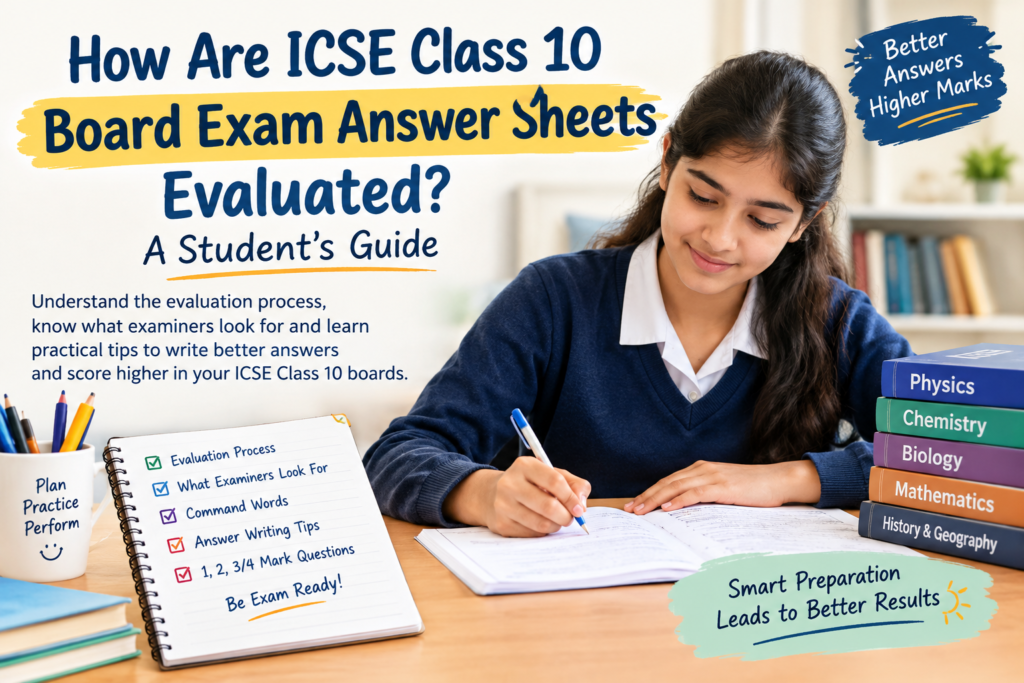
Preparing for the ICSE Class 10 board examinations is not only about completing the syllabus and memorising important topics. Students also need to understand how ICSE Class 10 answer sheets are evaluated, what is expected in a good answer and how to present their knowledge effectively.
Many students understand the concepts but lose marks because they do not answer the exact question, miss important points, skip steps in numerical problems, make calculation errors or present their answers unclearly.
So, how are ICSE Class 10 board exam answer sheets checked? What do examiners look for? How can students improve their ICSE Class 10 answer writing?
Let us understand the evaluation process and learn practical strategies for better board exam preparation.
How Are ICSE Class 10 Answer Sheets Evaluated?
ICSE Class 10 answers are evaluated according to the applicable board pattern, marking scheme and requirements of the question.
Depending on the subject and question, marks may be awarded for relevant:
- Concepts
- Facts
- Explanations
- Steps
- Calculations
- Diagrams
- Labels
- Examples
- Reasons
- Conclusions
Therefore, writing a lengthy answer does not automatically mean scoring more marks.
A good board exam answer should be: Correct + Relevant + Complete + Clearly Presented
The most important rule is:
Answer what the question asks—not everything you know about the topic.
What Do Examiners Look for in an ICSE Class 10 Answer?
1. Correct Concepts
Your answer should demonstrate that you understand the concept being tested.
For example, if a Physics question asks you to explain a phenomenon, simply writing its name may not be sufficient. You should explain the relevant scientific principle.
Similarly, in ICSE Class 10 Biology, Chemistry, History, Geography and other subjects, make sure your answer contains the appropriate facts, concepts and explanations.
Understand the concept first. Then practise writing it clearly.
2. Relevant Points
Marks are awarded for the relevant content required by the question.
If the question asks for three reasons, provide three relevant reasons.
If it asks for two differences, clearly provide two differences.
If it asks you to state, give the required fact or statement.
If it asks you to explain, provide the relevant explanation.
Before writing, ask yourself:
“What exactly is this question asking me to write?”
Understand the Command Words
The words used in a question often indicate what kind of answer is expected.
| Question Word |
What You Should Do |
| Define |
Give a precise definition |
| State |
Give the required fact or statement |
| Name |
Write the required term/name |
| List |
Provide the required points |
| Explain |
Give relevant details or reasons |
| Differentiate |
Clearly show differences |
| Compare |
Mention the required similarities/differences |
| Calculate |
Show the relevant working |
| Draw |
Draw the required diagram |
| Label |
Identify the required parts |
| Justify |
Give a suitable reason or explanation |
Understanding these command words can help you structure your answers more effectively.
How to Write Better Answers in ICSE Class 10 Board Exams
1. Answer Directly
Avoid unnecessary introductions.
If the question asks for a definition, begin with the definition.
If it asks for reasons, write the reasons.
If it asks for differences, use a table where appropriate.
The objective is to make the relevant information easy to identify.
2. Use Correct Subject-Specific Terms
Correct terminology is important in board examinations.
For example, in Physics you may need terms such as:
- Refraction
- Total internal reflection
- Potential difference
- Resistance
- Electromagnetic induction
In Biology, terms may include:
- Photosynthesis
- Transpiration
- Respiration
- Osmosis
- Blood clotting
Use keywords naturally and correctly.
Do not memorise keywords without understanding the concept behind them.
3. Write Long Answers in Clear Points
Long paragraphs can make important points difficult to identify.
Whenever appropriate, use:
- First point
- Second point
- Third point
For longer answers, suitable headings, tables or flowcharts can also improve organisation.
Remember: Good presentation means clarity—not decoration.
How to Attempt 1-Mark, 2-Mark and 3/4-Mark Questions
1-Mark Questions
Keep your answer precise.
If the question asks for a term, value or short fact, provide the required answer without unnecessary information.
2-Mark Questions
Make sure all required components are included.
For example, if a question asks for two reasons, clearly write two relevant reasons.
3- and 4-Mark Questions
Include the relevant points and explanations required by the question.
Depending on the subject, this may involve:
- Multiple points
- Explanation
- Steps
- Formulae
- Calculations
- Diagrams
- Examples
Do not write extra information simply to make the answer longer.
Why Step-by-Step Working Matters in ICSE Class 10 Numericals
For subjects such as ICSE Class 10 Mathematics and Physics, show the important steps in numerical problems.
A useful structure is:
Given → Formula → Substitution → Calculation → Final Answer
For example:
Given: Distance = 100 m; Time = 20 s
Formula: Speed = Distance / Time
Substitution: Speed = 100 / 20
Calculation: Speed = 5 m/s
Answer: Speed = 5 m/s
Always check your calculations and units before moving to the next question.
How Important Are Diagrams in ICSE Class 10?
Diagrams can be an important part of answers in subjects such as ICSE Class 10 Biology, Physics and Geography, when the question requires or benefits from a diagram.
A good exam diagram should be:
- Neat
- Relevant
- Clearly labelled
- Large enough to understand
- Appropriate to the question
If you are asked to draw and label a biological structure, make sure the required labels are clearly visible.
For Physics ray diagrams, show the appropriate rays, directions and labels required by the question.
Draw what is required—avoid unnecessary details.
How Should You Write Definitions?
Definitions should communicate the correct meaning of the term clearly and precisely.
Instead of memorising sentences mechanically, use this approach:
Understand → Identify key terms → Learn the definition → Practise writing it
Regular practice can make it easier to recall important definitions during the board examination.
How to Answer “Explain”, “Give Reasons” and “Justify” Questions
When a question asks you to explain, give reasons or justify, do more than simply state a fact.
A useful structure is: Statement → Reason → Explanation/Result
For example, if a Physics question asks why a phenomenon occurs, explain the relevant scientific principle rather than simply naming the phenomenon.
Similarly, for History or Geography questions, connect the relevant fact with the appropriate explanation.
Does Presentation Matter in ICSE Class 10 Answer Sheets?
Students often worry about whether handwriting and presentation affect their marks.
Your answer sheet does not need decorative borders or fancy formatting.
Instead, focus on making your answers clear, organised and readable.
Good answer presentation includes:
✔ Clear question numbering
✔ Legible handwriting
✔ Proper spacing
✔ Clearly visible diagrams
✔ Correct labels
✔ Logical steps in numericals
✔ Appropriate headings where useful
✔ Correct units
✔ Minimal overwriting
The goal is simple:
Make your knowledge easy to identify.
Common ICSE Class 10 Answer-Writing Mistakes
1. Not Reading the Complete Question
Students sometimes start writing after reading only part of the question.
Solution: Read the complete question before answering.
2. Missing a Sub-Part
If a question contains multiple requirements, make sure you answer every part.
3. Writing Irrelevant Information
More writing does not automatically mean more marks.
Stay focused on the question.
4. Skipping Steps in Numericals
Show the relevant working instead of writing only the final answer.
5. Forgetting Units
Check whether your numerical answer requires a unit.
6. Poorly Labelled Diagrams
When labels are required, ensure they are accurate and clearly visible.
7. Not Reviewing the Answer Sheet
Use the final few minutes to check calculations, question numbers, unanswered questions and other avoidable errors.
How Can You Improve ICSE Class 10 Answer Writing?
Answer writing improves through regular practice, evaluation and correction.
Follow this cycle:
Step 1: Understand the Concept
Do not begin by memorising answers. Understand the chapter first.
Step 2: Practise Chapter-Wise Questions
After completing a chapter, solve different question types from that topic.
Step 3: Write Under Exam Conditions
Practise writing answers on paper within a fixed time.
Step 4: Get Your Answer Sheet Evaluated
Evaluation helps you understand where you are losing marks and which areas need improvement.
Step 5: Compare with Model Answers
Compare your answer with the model answer and identify missing points or incorrect explanations.
Step 6: Analyse Your Mistakes
Check for:
- Missing points
- Incorrect concepts
- Calculation errors
- Poor presentation
- Incomplete answers
- Diagram mistakes
- Time-management issues
Step 7: Practise Again
Test → Correct → Analyse → Improve → Retest
This approach turns every test into an opportunity to improve.
Why Should You Review a Corrected Answer Sheet?
Your test score tells you how many marks you received.
Your corrected answer sheet helps you understand where you gained or lost marks.
By reviewing a corrected answer sheet, you can identify:
- Missing points
- Incorrect concepts
- Calculation mistakes
- Presentation issues
- Incomplete answers
- Diagram errors
- Questions that consumed too much time
This is why students should not simply check their marks and move on.
Analyse the paper. Learn from the corrections. Improve your next attempt.
Practise ICSE Class 10 Board-Pattern Questions with UT Udaan
Regular practice is an important part of ICSE Class 10 answer writing and board exam preparation. Solving questions on paper under a fixed time limit helps students become familiar with exam-style writing, improve time management, identify weak areas and build confidence for the board examination.
The ICSE Class 10 Test Series by UT Udaan includes chapter-wise tests and full-syllabus mock tests for ICSE Class 10 subjects. Students attempt the tests with pen and paper, similar to an actual written examination, and submit their handwritten answer sheets for evaluation. The answer sheets are manually evaluated according to the respective board pattern and marking scheme.
Students can receive their corrected answer sheets, marks, model answers and feedback, helping them identifies mistakes, understand areas for improvement and strengthen their answer-writing skills.
Sample Corrected ICSE Class 10 Answer Sheet
A sample corrected test paper has been attached below to help students understand how answers are evaluated.
Paper 01: Bio: https://utudaan.com/wp-content/uploads/2026/09/Sample-Corrected-Answer-Sheet.pdf
Use the sample corrected paper to:
- Identify where marks were lost
- Compare your answers with the model answers
- Find incomplete or incorrect responses
- Improve answer presentation
- Identify common mistakes
- Practise writing better answers in your next test
Don’t just check your marks. Analyse your corrected answer sheet and improve your next attempt.
A Simple Strategy for Better ICSE Class 10 Answers
Remember this simple approach: Understand → Plan → Write → Check → Improve
Understand: What exactly is the question asking?
Plan: What points, formula, diagram or explanation do I need?
Write: Present your answer clearly and logically.
Check: Have I answered every part of the question?
Improve: Learn from your corrected answer sheet, understand your mistakes and practise again.
This creates a simple improvement cycle:
Practise → Get Corrected → Analyse → Improve → Practise Again
Final Word
Scoring well in the ICSE Class 10 board examination is not only about completing the syllabus. You also need to develop strong answer-writing skills, time management, accuracy and exam presentation.
Focus on understanding the concept, reading the question carefully, using appropriate terminology, writing relevant points, showing necessary working, drawing accurate diagrams and learning from your corrected answer sheets.
Most importantly, do not treat a test only as a measure of your marks. Treat it as feedback for improvement.
Don’t Just Know the Answer. Learn to Present It.
Learn smart. Practise consistently. Revise strategically. Score confidently.
UT Udaan Test Series
UT Udaan provides structured test practice for students across different classes and boards. Choose the test series according to your class and board:
Practise, Analyse, and Improve, Repeat.