


Blog

Get Ready with Pen and Paper and Login to UTudaan Portal
Step 1

Select Topic and Start Exam
Step 2

Write Answers using pen and paper
Step 3

Complete Test & Take Photos of Answer Sheet
Step 4

Upload Answer Sheet PDF on Portal for Correction.
Step 5

End Exam and Your Answer Sheet is Submitted for Correction
Step 6

UT Teacher Correcting Your Answer Sheets
Step 7

View/Download Corrected Answer Sheet with Marks
Step 8

Improve Weak Topics by Using the Textbook, Corrected Answer Sheet, and Model Answers.
Step 9

www.UTudaan.com
Learn smart. Practise consistently. Revise strategically. Score confidently.
ICSE Class 10 Biology can be one of the highest-scoring subjects in the board exams if you prepare it with the right strategy. Instead of simply memorising definitions and diagrams, focus on understanding concepts, learning biological processes, practising diagrams and solving different types of questions.
The ICSE Biology syllabus contains concepts, processes, diagrams, applications, experiments and reasoning-based questions. A smart preparation strategy can help you understand these topics, remember them for longer and write better answers in the examination.
Whether you are looking for ICSE Class 10 Biology study tips, preparing for school prelims, revising before the board examination, or aiming to score 95% or more in Biology, this guide covers practical strategies for effective preparation.
How to Score 95%+ in ICSE Class 10 Biology?
To score 95%+ in ICSE Class 10 Biology, focus on five key areas:
- Understand concepts instead of memorising paragraphs.
- Practise and label important Biology diagrams.
- Learn biological processes using flowcharts.
- Master definitions, differences and scientific keywords.
- Solve application-based questions and timed mock papers.
These five areas form the foundation of effective ICSE Class 10 Biology preparation and can help you improve both accuracy and confidence.
Why Is ICSE Class 10 Biology a Scoring Subject?
Biology offers plenty of opportunities to score well because many questions are based on clearly defined concepts, standard diagrams, biological processes and scientific terminology.
However, students often lose marks because they:
- Memorise answers without understanding the concept.
- Skip diagrams and labelling practice.
- Confuse biological terms.
- Write incomplete explanations.
- Ignore keywords expected in answers.
- Do not practise application-based questions.
- Leave revision until the last moment.
The solution is simple:
Understand → Learn → Practise → Revise → Test
- Understand the Concept Before Memorising It
Instead of memorising an entire paragraph, first ask:
What is happening? Why is it happening? How does it happen?
For example, while studying photosynthesis, don’t simply memorise its definition.
Understand the basic process:
Photosynthesis
Plants prepare food using:
- Carbon dioxide
- Water
- Sunlight
- Chlorophyll
A simplified equation is: Carbon dioxide + Water → Glucose + Oxygen + Water
The important point is to understand the role of each factor rather than memorising the equation mechanically.
Exam Tip
If a question asks:
Why is chlorophyll necessary for photosynthesis?
Don’t simply write “because it is needed for photosynthesis.”
Write a complete scientific answer explaining that chlorophyll absorbs light energy required for photosynthesis.
For additional board-level practice, practise chapter-wise and board-pattern questions regularly with UT Udaan
- Master the Important ICSE Biology Diagrams
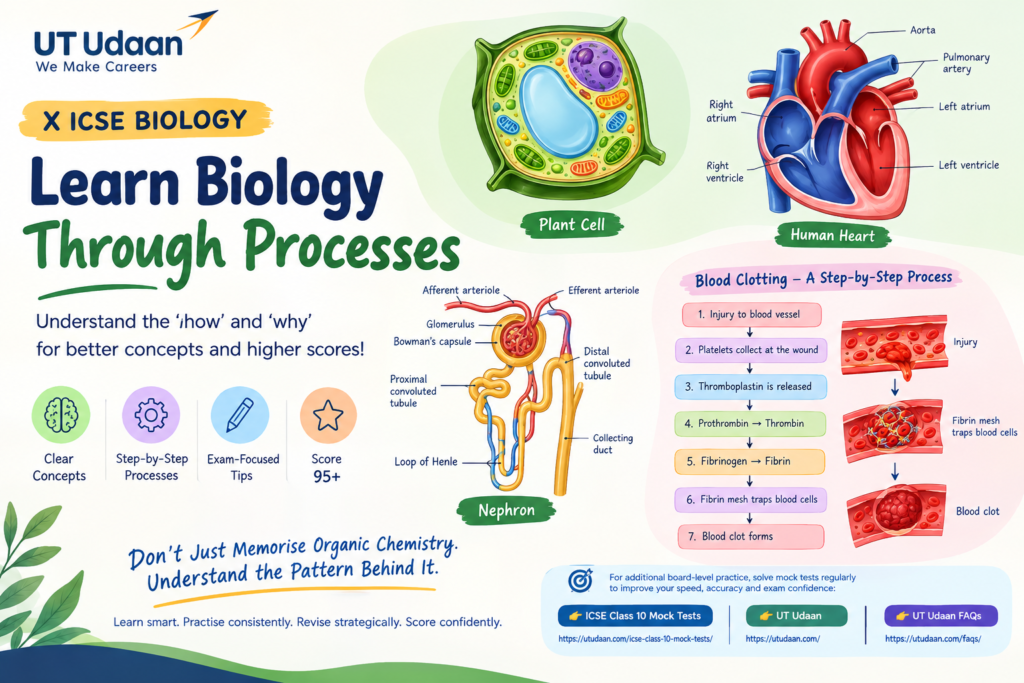
Diagrams are extremely important in ICSE Biology. Students should practise drawing and labelling diagrams rather than only looking at them in the textbook.
Common diagrams to practise
Depending on your syllabus, important diagrams may include:
- Human heart
- Nephron
- Neuron
- Human eye
- Human ear
- Male reproductive system
- Female reproductive system
- Reflex arc
- Structure of chromosome
- Stages of mitosis
- Root Hair cell
- Dihybrid/monohybrid inheritance representations
- Photosynthesis-related diagrams
A Simple Diagram Strategy
Use the D-L-L-R method:
D → Draw
L → Label
L → Learn the function
R → Re-draw from memory
For example:
Don’t just memorise the names. Understand the direction in which the impulse travels.
- Learn Biology through Processes
Many Biology chapters contain processes that become much easier when converted into flowcharts.
For example, understand blood clotting step by step:
Injury → Platelets collect at the wound → Thromboplastin is released → Prothrombin changes into thrombin → Fibrinogen changes into fibrin → Fibrin forms a mesh → Blood cells are trapped → Clot forms Blood Clotting – Quick Recall
Injury to blood vessel
↓
Platelets release thromboplastin
↓
Prothrombin → Thrombin
↓
Fibrinogen → Fibrin
↓
Fibrin mesh traps blood cells
↓
Blood clot forms
Exam Tip: Learn the sequence + key terms. This makes process-based questions much easier to answer accurately.
Your revision rule: If a biological process has steps, convert it into a flowchart.
This is particularly useful for:
- Reflex action
- Urine formation
- Double circulation
- Photosynthesis
- Menstrual cycle
- Fertilisation
- Genetic crosses
- Cell division
- Endocrine Glands
- Learn Important ICSE class 10 Biology Keywords
ICSE Biology answers often depend on the correct use of scientific terminology.
Create a separate notebook containing important keywords.
| Topic | Important Keywords |
| Photosynthesis | chlorophyll, sunlight, carbon dioxide, glucose |
| Respiration | glucose, oxygen, energy, mitochondria |
| Excretion | kidney, nephron, urine |
| Nervous system | stimulus, receptor, neuron, impulse |
| Genetics | gene, allele, dominant, recessive |
| Reproduction | fertilisation, zygote, implantation |
Before your examination, revise this keyword bank regularly.
Remember: Knowing the concept is important. Using the correct biological terminology is equally important.
- Don’t Ignore Differences and Definitions
ICSE Biology frequently tests precise terminology. Students should practise questions such as:
- Define a gene.
- What is a reflex action?
- What is transpiration?
- Define excretion.
- What is a hormone?
- Differentiate between artery and vein.
- Differentiate between aerobic and anaerobic respiration.
- Distinguish between genotype and phenotype.
Best Way to Learn Differences
Use a comparison table.
| Artery | Vein |
| Carries blood away from the heart | Carries blood towards the heart |
| Generally has thick muscular walls | Generally has thinner walls |
| Valves are generally absent | Valves are present |
This makes revision much faster.
- Practise Application-Based Questions
Don’t restrict your preparation to direct questions.
ICSE Board Exams can test whether you can apply your knowledge to a situation.
Example
Question:
A person accidentally touches a hot object and immediately withdraws their hand. Explain the pathway involved.
How to approach it:
Identify:
- Stimulus
- Receptor
- Sensory neuron
- Spinal cord/Brain
- Motor neuron
- Effector
- Response
This approach helps you answer unfamiliar questions using concepts you already know.
- Learn ICSE Class 10 Biology Genetics Step-by-Step
Genetics can seem difficult initially, but it becomes easier when you follow a fixed procedure.
For example:
Tall plant = T
Dwarf plant = t
Cross: Tt × Tt
| T | t | |
| T | TT | Tt |
| t | Tt | tt |
Result:
Genotypic ratio: 1 TT : 2 Tt : 1 tt
Phenotypic ratio: 3 Tall : 1 Dwarf
Don’t merely memorise 3:1.
Understand how the ratio is obtained.
- Learn Experiments With Their Purpose
For Biology experiments, don’t learn only the procedure.
Remember:
Aim → Materials → Procedure → Observation → Conclusion
For example, when studying an experiment related to photosynthesis, ask:
- What are we trying to prove?
- Why is the plant treated in a particular way?
- What is the observation?
- What does the observation prove?
This makes experimental questions much easier.
- How to Write High-Scoring Biology Answers
A good Biology answer should be:
✔ Precise: Avoid unnecessary explanations.
✔ Scientific: Use correct terminology.
✔ Structured: Use points wherever possible.
✔ Complete: Answer every part of the question.
✔ Well-labelled: Draw neat diagrams wherever required.
✔ Keyword-rich: Include the scientific terms relevant to the question.
For a 3-mark answer, don’t write one huge paragraph.
Instead:
Point 1: Explanation
Point 2: Explanation
Point 3: Explanation
This makes your answer easier to evaluate.
- Don’t Just Memorise Biology. Understand the Pattern Behind It.
A powerful way to prepare for ICSE Class 10 Biology is to identify patterns.
For every chapter, ask:
What?: What is the concept?
Why?: Why does the process occur?
How?: How does the process happen?
Where?: Where does it happen?
What happens if…? What happens if one factor changes?
Can I draw it?: Can I represent the concept using a diagram or flowchart?
This method transforms Biology from a memory-heavy subject into a concept-based subject.
Sample ICSE Class 10 Biology Questions with answers
Question 1 – Concept-Based
What is the role of chlorophyll in photosynthesis?
Ans: Chlorophyll absorbs light energy required for carrying out photosynthesis.
Question 2 – Diagram-Based
Draw a neat, labelled diagram of a nephron and state its main function.
Tip: Practise the diagram several times without looking at the textbook.
Question 3 – Reasoning-Based
Why are arteries generally more muscular than veins?
Ans: Arteries carry blood away from the heart under relatively high pressure. Therefore, they have thick, muscular and elastic walls.
Question 4 – Application-Based
A student accidentally touches a hot object and immediately withdraws the hand. Name the type of response and explain the pathway involved.
Key terms to include:
receptor → sensory neuron → spinal cord → motor neuron → effector → response.
Question 5 – Genetics
A tall pea plant heterozygous for height is crossed with another heterozygous tall plant. Represent the cross and state the phenotypic ratio.
Answer: Tt × Tt
Cross: Tt × Tt
| T | t | |
| T | TT | Tt |
| t | Tt | tt |
Phenotypic ratio: 3 Tall : 1 Dwarf
Question 6 – Short Answer
Differentiate between aerobic and anaerobic respiration.
| Aerobic Respiration | Anaerobic Respiration |
| Takes place in the presence of oxygen | Takes place in the absence of oxygen |
| Releases more energy | Releases less energy |
| Complete breakdown of glucose | Incomplete breakdown of glucose |
7-Day ICSE class 10 Biology Revision Plan
Day 1: Revise major concepts and definitions.
Day 2: Practise important diagrams and labelling.
Day 3: Revise processes using flowcharts.
Day 4: Practise differences, reasoning and application questions.
Day 5: Revise genetics and numerical/problem-based concepts.
Day 6: Attempt a full Biology mock paper.
Day 7: Analyse mistakes and revise weak chapters.
The most important step is Day 7.
Don’t just check your marks.
Ask:
- Which questions did I get wrong?
- Was the mistake conceptual?
- Did I miss a keyword?
- Did I misunderstand the question?
- Was my diagram incomplete?
- Did I run out of time?
Your mistakes tell you exactly what to revise.
Final Exam Checklist for ICSE Class 10 Biology
Before the examination, make sure you can:
☑ Explain important concepts without memorising paragraphs
☑ Draw and label important diagrams
☑ Recall key definitions
☑ Write biological differences correctly
☑ Explain processes in the correct sequence
☑ Solve genetics-based questions
☑ Answer reasoning questions
☑ Handle application-based questions
☑ Revise important keywords
☑ Complete timed mock tests
Final Word
Biology does not have to be a difficult subject in ICSE Class 10 Biology. With the right study strategy, you can strengthen your conceptual understanding, remember important processes, improve your diagram skills, and answer questions with greater confidence.
Build your fundamentals, understand biological processes instead of simply memorising them, learn important keywords, practise and label diagrams neatly, revise definitions and functions regularly, and connect concepts with their applications. Use active recall, solve different types of questions, practise regularly, and learn from your mistakes.
Learn smart. Practise consistently. Revise strategically. Score confidently.
With focused preparation and regular ICSE Class 10 Biology practice, you can turn challenging topics into scoring opportunities and work confidently towards 95%+ in Biology.
Test your ICSE Biology preparation
Understanding concepts is only the first step. The best way to identify weak areas is to solve timed questions and analyse your mistakes.
Practise with ICSE Class 10 Mock Tests
Have More Questions?
Have more questions about the test series or board preparation?
Visit the UT Udaan FAQ page: UT Udaan FAQs