Scoring well in board exams does not just about know the correct answer. It is also about how clearly, accurately and completely you write it.
Many students understand a chapter but still lose marks because their answers miss important points, lack proper explanations or are not presented clearly.
So, what makes a good board exam answer? Let’s understand the difference between strong and weak answers with simple examples.
What Makes a Good Board Exam Answer?
A good answer directly addresses the question and includes the necessary points without unnecessary explanation.
Here are FIVE QUALITIES of a strong board exam answer:
- Relevance: Answer exactly what the question asks.
- Accuracy: Include correct facts, concepts, formulas and calculations.
- Completeness: Cover all the required points.
- Presentation: Use clear steps, paragraphs, headings or diagrams wherever appropriate.
- Keywords: Include important subject-specific terms.
Remember, a longer answer does not automatically earn more marks. Your answer should match the question and its mark allocation.
Strong vs Weak Answers: Examples
Example 1: Science — Photosynthesis
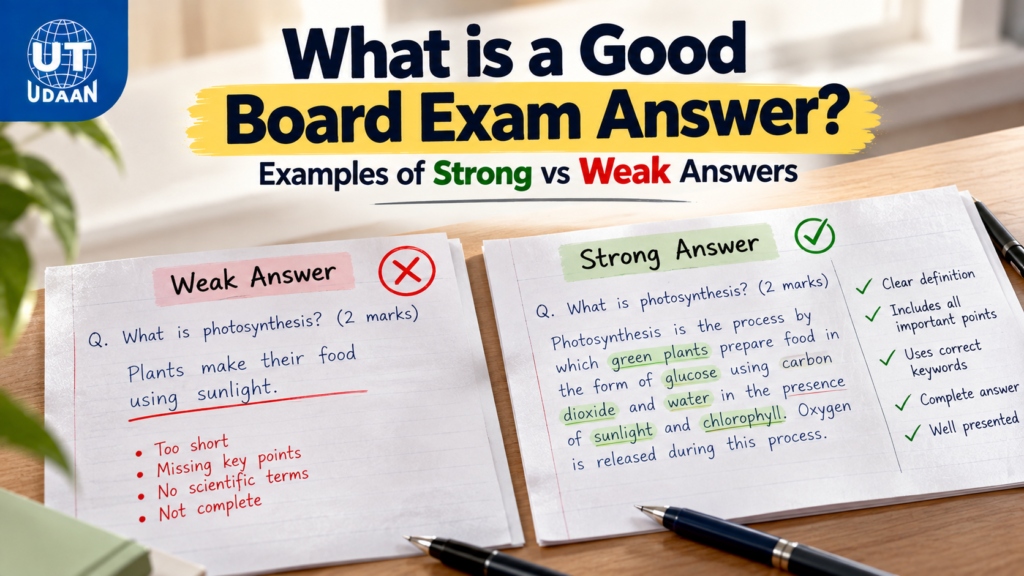
Question: What is photosynthesis? (2 marks)
Weak answer: Plants make their food using sunlight.
Why is it weak?
- It gives only a basic idea.
- It does not explain the role of carbon dioxide and water.
- It misses important scientific details.
Strong answer:
Photosynthesis is the process by which green plants prepare food in the form of glucose using carbon dioxide and water in the presence of sunlight and chlorophyll. Oxygen is released during this process.
Why is it stronger?
- It gives a clear definition.
- It includes essential scientific terms.
- It explains the process more completely.
Example 2: Mathematics — Showing Working
Question: Solve (2x+6=16). (3 marks)
Weak answer: [x=5]
Why is it weak?
The final answer is correct, but the working is not shown. Depending on the question and marking scheme, marks may be awarded for relevant steps as well as the final answer.
Strong answer:
[ 2x+6=16]
[2x=16-6]
[2x=10]
[x=5]
Why is it stronger?
- Each step is clearly presented.
- The method can be followed easily.
- The examiner can assess the working as well as the final answer.
Example 3: Biology — Explaining a Process
Question: State two functions of red blood cells. (2 marks)
Weak answer:
Red blood cells carry oxygen and help the body.
Why is it weak?
- The second point is vague.
- It does not clearly state two functions.
Strong answer:
- Red blood cells transport oxygen from the lungs to body tissues using hemoglobin.
- They help transport a portion of the carbon dioxide from body tissues towards the lungs.
Why is it stronger?
- Both points are clearly stated.
- Relevant scientific terminology is used.
- Each point addresses the question directly.
Example 4: Social Science — Giving Reasons
Question: Why is rainwater harvesting important? State two reasons. (2 marks)
Weak answer:
Rainwater harvesting is important because water is useful and we need to save it.
Why is it weak?
- The explanation is general.
- It does not provide two distinct reasons.
Strong answer:
- Rainwater harvesting helps recharge groundwater resources.
- It reduces surface runoff and helps conserve water for future use.
Why is it stronger?
- It provides two separate reasons.
- Each point is specific and relevant.
- The answer is concise and easy to evaluate.
5 Common Mistakes That Make Students Lose Marks
Avoid these mistakes while writing board exam answers:
- Writing vague answers: Use precise facts and explanations instead of general statements.
- Skipping steps: Show relevant working in Mathematics and numerical questions.
- Ignoring keywords: Use correct subject terminology wherever required.
- Writing unnecessary information: Focus on what the question asks.
- Ignoring feedback: Review corrected answer sheets and understand why marks were deducted.
How Can You Improve Your Board Exam Answer Writing?
The best way to improve is to practise writing answers and review your performance regularly.
Follow these steps:
- Practise chapter-wise and full-length mock tests.
- Write answers according to the marks and requirements of each question.
- Compare your answers with model answers where available.
- Review corrections and identify missing points.
- Rewrite weak answers using the feedback received.
This process helps you recognise common mistakes and develop better answer-writing habits.
Practise with UT Udaan
UT Udaan helps students prepare through chapter-wise tests and board-pattern mock tests, giving them opportunities to practise questions under test conditions.
Students can use their test performance to identify weak concepts, improve answer writing, revise mistakes and practise again.
UT Udaan provides structured test practice for students across different classes and boards. Choose the test series according to your class and board:
Final Takeaway
A good board exam answer is not necessarily the longest answer. It is the answer that is correct, relevant, complete and clearly presented.
Understand the question, include the necessary points, show your working where required and learn from every correction.
Write better answers. Learn from your mistakes. Prepare smarter with UT Udaan.