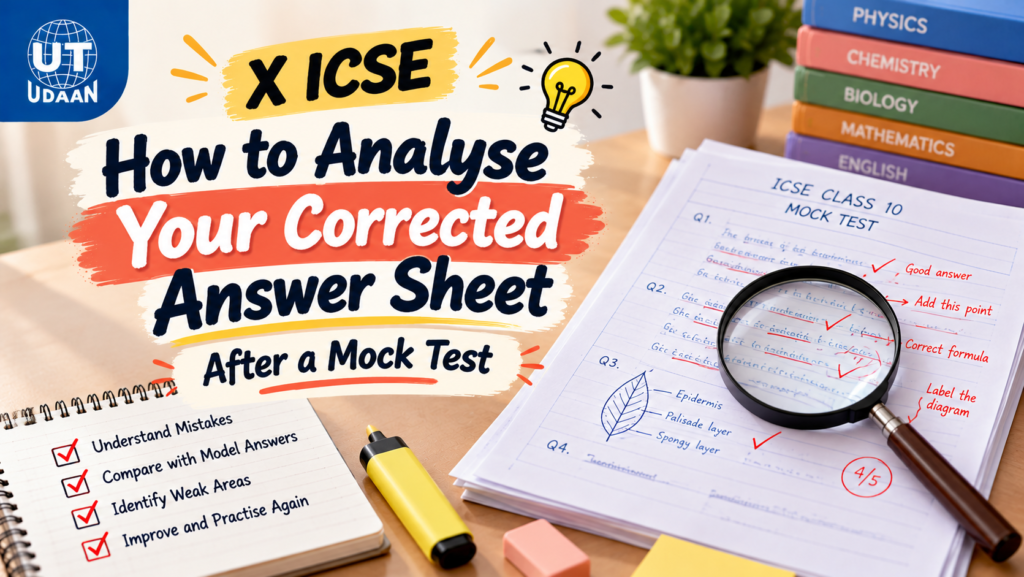
Taking a mock test is important, but analysing your corrected answer sheet is where real improvement begins. Your marks tell you how you performed, while your corrected paper helps you understand what to improve before the actual board exam.
Whether you are preparing for the ICSE or CBSE Class 10 Board Exams, follow these simple steps to make every mock test count.
-
Check Where You Lost Marks
Don’t look at your total score and move on. Go through every question where marks were deducted.
Ask yourself:
- Did I misunderstand the question?
- Did I miss an important point?
- Was my answer incomplete?
- Did I make a calculation or spelling mistake?
- Did I forget a formula, diagram or keyword?
Understanding why you lost marks is the first step towards improving your score.
-
Understand the Examiner’s Feedback
Read the corrections and comments carefully. They can help you understand what was missing from your answer and how you can improve it.
Pay attention to:
- Missing keywords and important points
- Incorrect or incomplete steps
- Poor answer presentation
- Missing diagram labels or units
- Answers that do not address the question properly
Don’t just check what was wrong. Learn what a better answer should include.
-
Compare Your Answers with Model Answers
Use the model answers provided with your evaluated paper, where available.
Compare your response with the suggested answer and identify the difference. You may have understood the concept but missed important details or failed to explain it clearly.
Remember, writing more is not always better. Focus on writing relevant, accurate and complete answers.
-
Identify Your Mistake Pattern
One mistake may be accidental, but repeating the same mistake across multiple tests signals an area that needs attention.
For example:
|
Mistake
|
What You Should Do
|
| Forgetting formulas |
Revise formulas and practise related questions |
| Incomplete answers |
Practise writing all required points |
| Calculation errors |
Show working and verify calculations |
| Poor time management |
Attempt full-length papers under timed conditions |
| Missing keywords |
Review model answers and subject terminology |
| Incorrect diagrams |
Practise drawing and labelling diagrams |
-
Revise Weak Chapters Before Taking Another Test
Once you identify your weak areas, revisit the relevant chapters.
Don’t rush into another mock test without correcting the mistakes from the previous one.
Follow this cycle: Attempt → Evaluate → Analyse → Revise → Practise Again
This helps you use each test as an opportunity to improve.
-
Maintain a Mistake Notebook
Keep a small notebook to record recurring errors, difficult concepts, forgotten formulas and important feedback.
Before your next mock test, review this notebook. It will help you focus on the areas that need the most attention.
-
Track Your Progress Across Tests
Compare your performance across successive mock tests. Look beyond the total marks and check whether you are making fewer mistakes, improving your answer writing and completing papers on time.
The aim is not simply to score higher in one test. It is to develop consistent exam skills.
Practise with UT Udaan
UT Udaan helps students prepare through chapter-wise tests and board-pattern mock tests, giving them opportunities to practise questions under test conditions.
Students can use their test performance to identify weak concepts, improve answer writing, revise mistakes and practise again.
UT Udaan provides structured test practice for students across different classes and boards. Choose the test series according to your class and board:
Final Takeaway
Your corrected answer sheet is more than a record of your marks. It is a guide to what you should improve next.
Don’t just count the marks you scored. Understand the marks you lost.
Analyse every test, correct your mistakes and practise again.
UT Udaan — Practise. Evaluate. Improve. Repeat.