Have you ever wondered why two students who get the same final answer can sometimes receive different marks?
The answer often lies in how the answer is written and how the marks are allocated to different parts of the solution.
For subjects such as Mathematics and Science, showing the correct steps can be an important part of written practice. In other subjects too, marks may be awarded for specific points, explanations, keywords or components of an answer.
This is why students preparing for the CBSE Class 10 Board Exams should not focus only on getting the final answer correct.
They should also learn how to write the complete answer clearly and correctly.
What Is Step Marking?
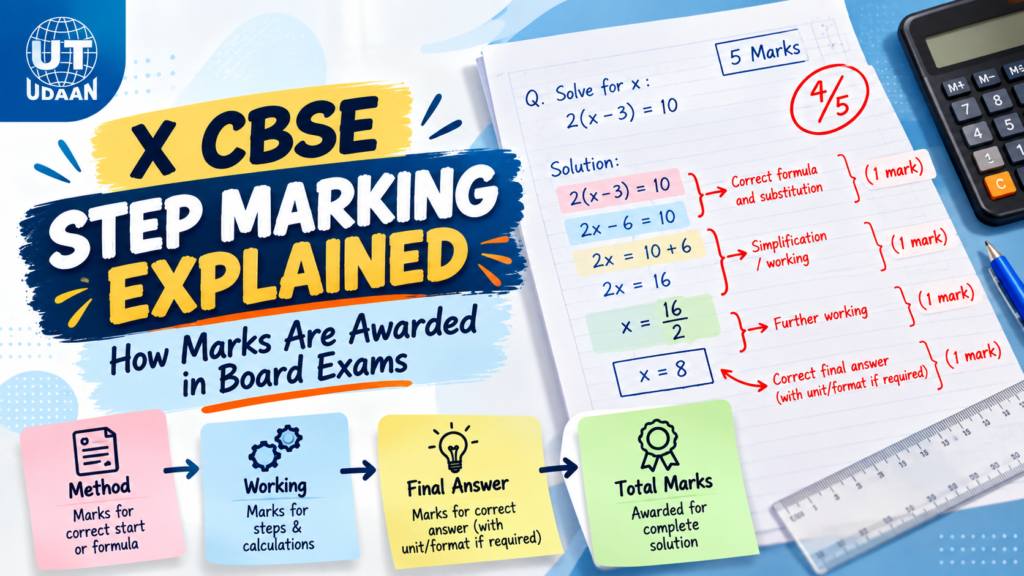
Step marking means that marks can be allocated to different parts or components of a question according to the applicable marking scheme.
For example, a numerical question may require a student to:
- Write the correct formula.
- Substitute the given values.
- Perform the calculation.
- Write the final answer with the appropriate unit.
Depending on the question and its marking scheme, different parts may carry different marks.
Therefore, writing only the final answer may not demonstrate all the work expected in the solution.
CBSE publishes subject-wise Sample Question Papers and Marking Schemes for Class X. The current 2026–27 Class X page includes marking schemes for subjects such as Mathematics, Science, Social Science and English.
Why Should Students Understand Step Marking?
Understanding how marks are allocated can change the way students write their answers.
Instead of thinking:
“I just need the final answer.”
students should think:
“I need to show the important parts of my solution.”
This is particularly useful for:
- Mathematics
- Physics
- Chemistry
- Accountancy
- Economics
- Other subjects involving calculations, reasoning or structured responses
It can also help students understand why working, explanations and relevant points matter.
Step Marking in Mathematics
Mathematics is one of the clearest examples of why showing your work matters.
Suppose a question requires you to solve a mathematical problem.
A well-presented solution may include:
Step 1: Write the formula or method: Identify the appropriate formula or mathematical relationship.
Step 2: Substitute the values: Put the given information into the formula correctly.
Step 3: Show the calculation: Work through the calculation clearly.
Step 4: Write the final answer: State the answer clearly, with the required unit where applicable.
Example:
Instead of writing only: Answer = 25 cm
Show the relevant working that leads to the answer.
This makes your solution easier to follow and allows the evaluator to see how you reached the result.
The exact allocation of marks depends on the question and its applicable marking scheme, so students should not assume that every Mathematics question always follows the same step-wise mark split.
Step Marking in Science
Step-wise presentation can also be useful in CBSE Class 10 Science.
For numerical questions, students should generally practise showing:
Formula → Substitution → Calculation → Answer
For theory questions, students should focus on the specific points required by the question.
For example, if a question asks you to explain a process, simply mentioning the name of the process may not be enough.
The answer may need:
- The correct concept
- Relevant explanation
- Important scientific terms
- Required steps
- A diagram, where appropriate
The marking scheme indicates the relevant value points for the question.
Does Step Marking Mean Every Step Gets One Mark?
Not necessarily.
This is an important point students should understand.
There is no universal rule that says: “Every step = 1 mark.”
The distribution of marks depends on the question and the applicable marking scheme.
CBSE’s marking-scheme documents provide value points and instructions for evaluation. CBSE’s official evaluation guidance also states that evaluation is to be carried out according to the marking scheme and that value points can represent the expected elements of an answer.
Therefore, students should avoid memorising a fixed rule for step marking.
Instead, they should learn to: Read → Understand → Solve → Show Relevant Working → Check
What Happens If the Final Answer Is Wrong?
This is one of the most common questions students ask.
Suppose a student uses the correct method but makes a calculation mistake near the end.
The marks awarded depend on the specific question and marking scheme.
In some questions, the earlier correct work may demonstrate valid understanding even if the final result is incorrect. In other questions, the marking scheme may require particular value points or outcomes.
Therefore: Never assume that a wrong final answer automatically means zero marks.
At the same time, students should not assume that showing several steps automatically guarantees marks.
The work must be relevant and correct according to the requirements of the question.
What If You Write Only the Final Answer?
Writing only the final answer can be risky for questions that require working, reasoning or explanation.
Consider a numerical problem.
Student A: Writes only: Answer = 48
Student B: Shows:
Formula
↓
Substitution
↓
Calculation
↓
Final Answer = 48
Student B has made the solution easier to follow.
The exact marks awarded depend on the question and its marking scheme, but students should develop the habit of showing relevant working rather than relying only on the final answer.
Step Marking Is Not Only About Mathematics
The idea of showing the required components of an answer applies beyond numerical subjects.
Social Science: If a question asks for reasons, students should provide the required reasons rather than writing unrelated information.
English: Students should address the specific requirements of the question and follow the relevant writing format where applicable.
Science: Students should include the relevant concepts, explanations, equations, diagrams or calculations required by the question.
Economics and Accountancy: Students should show appropriate calculations, formats, working and explanations where required.
The common principle is simple:
Answer what the question asks and show the relevant work.
How Can Students Practise Step-Wise Answer Writing?
The best way to improve is through regular written practice.
After studying a chapter:
- Solve Questions: Attempt questions without looking at the solution.
- Show Your Working: Write the relevant formulas, steps, calculations and explanations.
- Check the Marking Scheme: Compare your response with the applicable marking scheme or model answer.
- Find Missing Points: Identify anything important that you left out.
- Rewrite the Answer: Practise writing the improved version.
This process helps students understand not only what the answer is, but also how the answer should be presented.
Why Subjective Tests Are Important
Reading solutions is not the same as writing solutions.
Students need to practise writing under test conditions because the board examination requires them to produce answers within a fixed time.
A subjective test series gives students an opportunity to practise:
- Writing complete answers
- Showing steps
- Managing time
- Applying concepts
- Presenting calculations
- Drawing diagrams
- Explaining reasoning
- Reviewing mistakes
Evaluation then shows students where they need to improve.
Practise Step-Wise Answers with UT Udaan
UT Udaan helps students prepare through chapter-wise tests and board-pattern mock tests, giving them opportunities to practise questions under test conditions.
Students can use their test performance to:
- Identify weak concepts
- Improve answer writing
- Understand mistakes
- Improve step-wise solutions
- Revise difficult topics
- Practise again
The aim is not simply to complete more tests.
The aim is to learn from each test and improve the next answer.
Practise → Get Evaluated → Identify Mistakes → Improve → Practise Again
Students preparing for CBSE Class 10 can explore: CBSE Class 10 Test Series – Chapterwise & Full Syllabus
Simple Step-Marking Checklist for Students
Before submitting your answer sheet, ask yourself:
✓ Did I read the question carefully?
✓ Did I use the correct formula or method?
✓ Did I show the relevant working?
✓ Did I include the important points?
✓ Did I write the final answer clearly?
✓ Did I include units where required?
✓ Did I check my calculations?
✓ Did I label my diagrams correctly?
✓ Did I answer every part of the question?
✓ Did I leave enough time to check my answers?
These small habits can make your written answers clearer and more complete.
Final Takeaway
Step marking is not a shortcut to getting marks. It is a reminder to show the relevant parts of your solution or answer clearly.
The exact allocation of marks depends on the question and the applicable marking scheme.
So, instead of focusing only on the final answer, develop the habit of showing your method, reasoning, calculations and relevant points wherever the question requires them.
Don’t just write the answer. Show how you reached it.
Practise. Write. Get Evaluated. Improve.
Practise with UT Udaan
UT Udaan helps students prepare through chapter-wise tests and board-pattern mock tests, giving them opportunities to practise questions under test conditions.
Students can use their test performance to identify weak concepts, improve answer writing, revise mistakes and practise again.