Preparing for the ICSE Class 10 Board Examination is not only about completing the syllabus and memorising important concepts. Students also need to practise writing answers, solving questions within a fixed time and presenting their knowledge effectively in an examination.
This is where an ICSE Class 10 subjective test series can make a difference.
Unlike objective tests, subjective tests require students to actually write their answers. This gives students an opportunity to practise the skills they will need in their board examination—answer presentation, step-by-step working, explanations, diagrams, calculations, keywords and time management.
But with many test series available, an important question arises:
What should students look for in an ICSE Class 10 subjective test series?
A good test series should not stop at giving students a question paper and a score.
It should help students understand:
What did I write correctly?
Where did I lose marks?
Why did I lose those marks?
How can I improve my answer next time?
Let’s look at the important features students should consider.
-
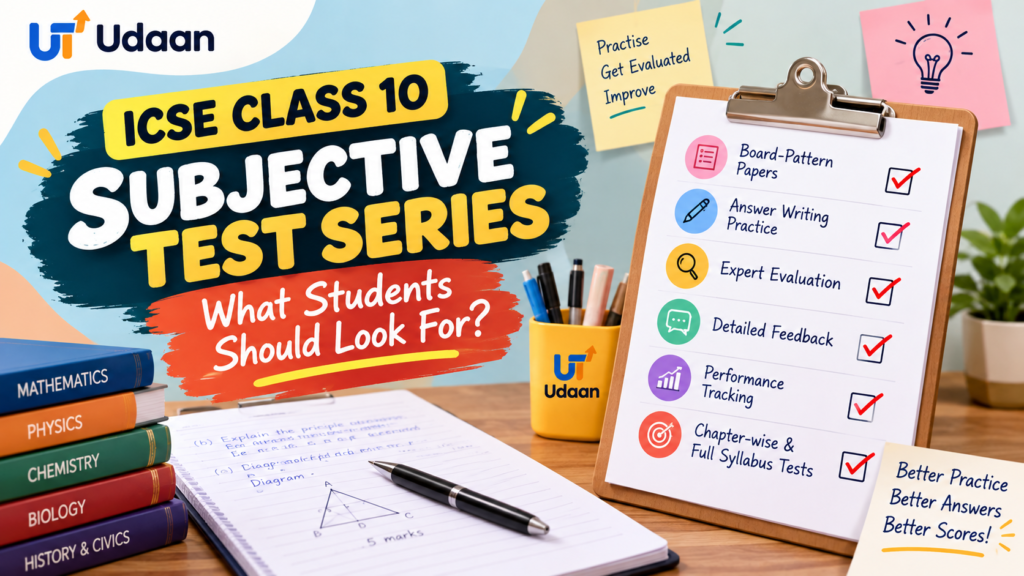
ICSE Board-Pattern Question Papers
The first thing students should check is whether the test papers are designed according to the ICSE Class 10 examination pattern and syllabus.
A useful test series should provide questions that allow students to practise different levels and types of questions, including:
- Short-answer questions
- Structured questions
- Application-based questions
- Reasoning questions
- Numerical problems
- Diagram-based questions
- Source or data-based questions, where applicable
- Long-answer questions
The objective should be to give students meaningful practice rather than simply increasing the number of questions they solve.
-
Subjective Answer Writing Practice
Students often spend considerable time reading and revising but comparatively less time actually writing answers.
This can become a problem in the board examination.
A subjective test series should give students regular opportunities to practise writing complete answers.
For example, students should practise:
- Explaining concepts clearly
- Showing steps in numerical problems
- Writing appropriate keywords
- Giving reasons where required
- Supporting answers with relevant points
- Drawing diagrams where necessary
- Labelling diagrams correctly
- Presenting answers according to the marks allotted
The more students practise writing, the easier it becomes to identify areas where their answer presentation needs improvement.
-
Proper Evaluation of Handwritten Answers
This is one of the most important features students should look for.
A subjective test series should ideally allow students to submit their actual handwritten answer sheets for evaluation.
Why is this important?
Because a student may know the correct concept but still lose marks because of:
- Missing points
- Incomplete explanations
- Incorrect terminology
- Poor presentation
- Missing steps
- Incorrect diagrams
- Calculation errors
- Not answering all parts of a question
A written test provides an opportunity to identify these issues.
-
Evaluation According to the Marking Scheme
A score alone does not tell a student enough.
Students should look for a test series where answers are evaluated using an appropriate marking-scheme-based approach.
For example, if a question carries several marks, the student should understand whether the answer contains the necessary points or steps required for those marks.
This helps students understand an important difference:
“My answer is broadly correct” does not always mean “I have included everything required for the marks.”
Marking-scheme-oriented evaluation can make this distinction clearer.
-
Corrected Answer Sheets
One of the most useful features of a subjective test series is receiving the corrected answer sheet after evaluation.
A corrected paper allows students to go back to the exact answer they wrote and compare it with the expected response.
Instead of simply seeing:
Marks: 62/80
students can ask:
- Which answer lost marks?
- Which step was missing?
- Which point was incorrect?
- Did I misunderstand the question?
- Was my explanation incomplete?
- Did I make a calculation error?
- Was my diagram properly labelled?
This makes the test more useful as a learning tool.
-
Detailed Feedback
A good subjective test series should provide meaningful feedback rather than only displaying a final score.
Useful feedback can help students identify:
Conceptual Errors: The student needs to revise the underlying concept.
Answer-Writing Errors : The student knows the concept but needs to improve the way it is presented.
Presentation Errors: The answer may need better organisation, steps, diagrams or labels.
Accuracy Errors: The student needs to improve calculations, formulas, spelling of technical terms or other details.
Time-Management Issues: The student may need more practice completing the paper within the allotted time.
The purpose of feedback should be to help students decide what to do next.
-
Chapter-Wise Tests
Students should not have to wait until the entire syllabus is completed before taking tests.
A useful ICSE Class 10 test series should provide chapter-wise practice.
Chapter-wise tests can help students:
- Check understanding after completing a chapter
- Identify weak concepts early
- Practise important question types
- Revise before moving to the next topic
- Build confidence gradually
A simple preparation cycle is: Study → Chapter Test → Analyse → Revise → Practise Again
-
Full-Syllabus Mock Tests
Chapter-wise tests are useful during preparation, but students also need experience with complete papers.
Full-syllabus mock tests help students practise:
- Sitting through a complete examination
- Managing time across sections
- Switching between different chapters
- Maintaining concentration
- Attempting questions strategically
- Reviewing answers before submission
As the examination approaches, students should gradually increase their full-paper practice.
-
Subject-Specific Evaluation
Different ICSE subjects require different answer-writing approaches.
For example:
ICSE Mathematics
Students should receive practice in:
- Step-by-step solutions
- Formula application
- Calculations
- Geometrical reasoning
- Proper working
- Accuracy
ICSE Physics
Students should practise:
- Numerical problems
- Formula application
- Units
- Definitions
- Explanations
- Diagrams and reasoning
ICSE Chemistry
Students should focus on:
- Chemical equations
- Reactions
- Conditions and observations
- Definitions
- Reasoning
- Numerical problems
ICSE Biology
Students should practise:
- Definitions
- Processes
- Structured answers
- Diagrams
- Labelling
- Biological terminology
ICSE History & Civics / Geography
Students should focus on:
- Relevant facts
- Keywords
- Structured answers
- Reasons and explanations
- Map work where applicable
- Data or application-based questions
A test series becomes more useful when the evaluation considers the requirements of the subject.
-
Performance Tracking
Students should be able to understand their progress over time.
For example:
| Test |
Score |
Main Issue |
Action Taken |
| Test 1 |
58/80 |
Conceptual errors |
Revised weak chapters |
| Test 2 |
64/80 |
Answer presentation |
Practised structured answers |
| Test 3 |
69/80 |
Time management |
Practised timed paper |
| Test 4 |
73/80 |
Minor errors |
Final revision |
The purpose of tracking is not to compare yourself with another student.
It is to compare your current performance with your previous performance.
-
Easy Access to Corrected Papers and Feedback
Students should also consider how easily they can access:
- Submitted answer sheets
- Corrected papers
- Marks
- Model answers
- Teacher/expert feedback
- Previous test performance
Keeping these resources available makes revision easier.
Students can revisit older mistakes before attempting the next test.
-
A Test Series Should Create an Improvement Cycle
The most important question students should ask before choosing a subjective test series is:
“What happens after I submit my paper?”
If the process ends with a score, the learning opportunity is limited.
A more useful cycle is:
Attempt the Test
↓
Submit Handwritten Answer Sheet
↓
Expert Evaluation
↓
Receive Marks & Corrections
↓
Review Mistakes
↓
Revise Weak Concepts
↓
Practise Again
↓
Attempt the Next Test
This turns testing into an ongoing improvement process.
Practise with UT Udaan
UT Udaan provides structured test practice for students through chapter-wise tests and board-pattern mock tests.
For students preparing for the ICSE Class 10 Board Examination, regular subjective practice can help them become familiar with writing complete answers under test conditions.
Students can use their test performance to:
- Identify weak concepts
- Improve answer writing
- Understand mistakes
- Revise difficult topics
- Practise again
- Improve speed and accuracy
The focus is not simply on taking more tests.
It is on learning from each test and improving the next performance.
ICSE Class 10 Test Series
ICSE Class 10 Test Series – Chapterwise & Full Syllabus
Students can use chapter-wise tests during preparation and full-syllabus tests as they move closer to their board examination.
What Should Students Check Before Choosing an ICSE Class 10 Subjective Test Series?
Before enrolling, students and parents can use this checklist:
| Feature |
What to Look For |
| Board Alignment |
ICSE syllabus and examination pattern |
| Question Quality |
Relevant, syllabus-based and varied questions |
| Subjective Practice |
Actual handwritten answer writing |
| Evaluation |
Proper evaluation of written responses |
| Marking |
Marks awarded according to appropriate criteria |
| Corrections |
Errors identified on the answer sheet |
| Model Answers |
Useful reference answers |
| Feedback |
Clear areas for improvement |
| Chapter Tests |
Topic/chapter-wise practice |
| Mock Tests |
Full-syllabus examination practice |
| Performance Tracking |
Ability to monitor improvement |
| Re-practice |
Opportunity to learn from mistakes and practise again |
Why Subjective Practice Matters for ICSE Class 10
Studying a chapter and writing an answer based on that chapter are two different skills.
A student may be able to explain a concept verbally but struggle to present it correctly in an examination.
Regular subjective practice helps students develop the habit of: Reading → Thinking → Structuring → Writing → Checking
This is why students should include written tests in their preparation rather than depending entirely on reading, revision and objective quizzes.
Final Checklist for ICSE Class 10 Students
Before choosing a subjective test series, ask:
Does it follow the ICSE syllabus?
Does it provide chapter-wise practice?
Does it include full-syllabus tests?
Can I practise writing complete answers?
Is my handwritten answer sheet evaluated?
Will I receive corrections?
Can I understand where I lost marks?
Will I receive useful feedback?
Can I use my mistakes to improve my next test?
If the answer to these questions is clear, students can make a more informed decision about the kind of test practice they need.
Prepare. Write. Get Evaluated. Improve.
Board preparation is not complete when you finish reading a chapter.
It becomes stronger when you can write what you know accurately, clearly and within the required time.
That is why subjective test practice should be an important part of your ICSE Class 10 Board Exam preparation.
Use every test as feedback.
Attempt the paper.
Understand your mistakes.
Revise the weak areas.
Practise again.
Practise Smarter. Write Better. Improve with Every Test.
Practise with UT Udaan – ICSE Class 10 Test Series
UT Udaan – Structured Test Practice for Better Preparation.