“I understand the chapter, but I still lose marks in Maths.”
“I practise questions, but I get stuck in the exam.”
“Maths is just not my subject.”
If these thoughts sound familiar, you’re not alone. Many students believe toppers are “naturally good at Maths.” But the truth is that high-scoring students follow a smart and consistent method.
They don’t just solve more questions. They know what to practise, how to practise, and how to learn from their mistakes.
The good news? You can follow the same approach.
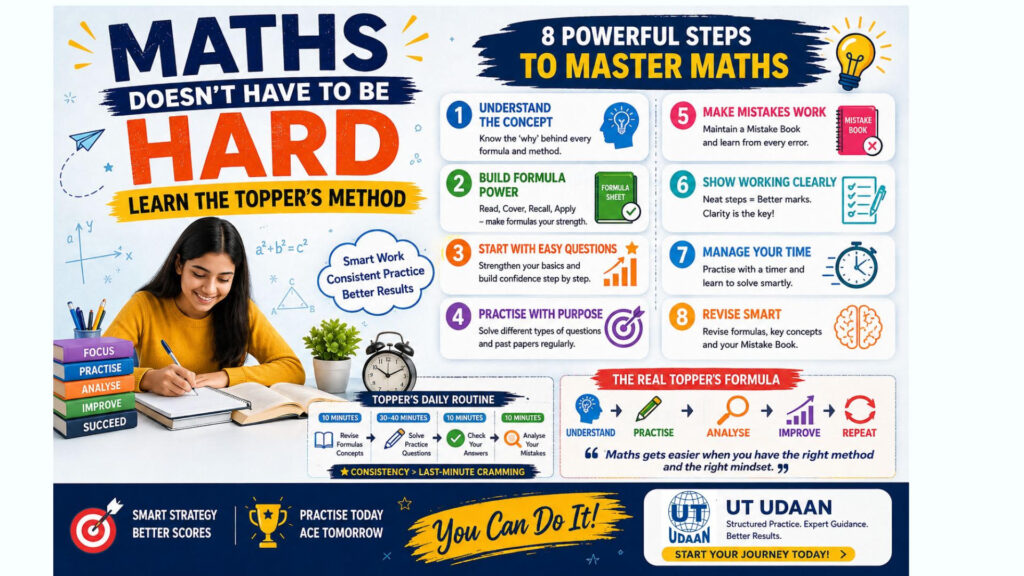
The Topper’s Method: Understand → Practise → Analyse → Improve
1. Understand the Concept
Before solving questions, make sure you understand the concept. Don’t memorise formulas blindly. Ask yourself:
- What concept is being used?
- Which formula applies?
- Why does this formula work?
- When should I use it?
Example: Quadratic Equations
Don’t just memorise the quadratic formula. Understand when to use factorisation, completing the square, or the quadratic formula.
Concept clarity comes before question-solving.
2. Build Formula Power
Formulas are your tools. Create a formula sheet for each chapter and follow this simple cycle:
Read → Cover → Recall → Apply
Learn a formula, close your book, write it from memory, and then apply it to a question.
This simple process strengthens both recall and application.
3. Start with Easy Questions
Don’t jump straight into the toughest problems. Build your skills gradually:
Basic → Moderate → Challenging
Starting with easier questions helps you build accuracy and confidence before moving to more complex problems.
A difficult question becomes easier when your basics are strong.
4. Practise with Purpose
Toppers don’t solve random questions. They practise different question patterns, including:
- Concept-based questions
- Application problems
- Word problems
- Higher-order questions
- Previous board papers
- Sample and specimen papers
When you face a new problem, pause and ask:
What is given? → What do I need to find? → Which concept applies?
For additional board-level practice, you can also solve mock tests: 👉 ICSE Class 10 Mock Tests
5. Make Your Mistakes Work for You
Making mistakes in Maths is normal. The real problem is repeating the same mistake without understanding why it happened.
This is where a Mistake Book can make a big difference.
Instead of simply checking the correct answer and moving on, take a few minutes to analyse every mistake.
What Should You Write in Your Mistake Book?
For every incorrect question, record:
- The Question – Write or note the question you got wrong.
- Your Mistake – Identify exactly where you went wrong.
- Correct Method – Write the correct approach step by step.
- Concept Missed – Mention the formula, theorem, rule, or concept you misunderstood.
- How to Avoid It – Write one short reminder for yourself.
Example
Suppose you make a sign error while solving an algebraic equation.
Instead of simply writing the correct answer, note:
Mistake: Changed the sign incorrectly while transposing a term.
Correct Method: A term changes its sign when moved to the other side.
Reminder: Check every sign before the next step.
This small habit can prevent the same error from appearing again.
Common Types of Maths Mistakes
1. Concept Mistakes
You may use the wrong theorem, formula, or method because the underlying concept is unclear.
How to improve: Go back to the concept before solving more questions.
2. Calculation Mistakes
You know the correct method but make an arithmetic, sign, multiplication, division, or simplification error.
How to improve: Slow down during calculations and check important intermediate steps.
3. Formula Mistakes
You remember a formula incorrectly or use the wrong formula.
How to improve: Revise formulas regularly and practise applying them instead of only memorising them.
4. Reading Mistakes
You misunderstand what the question is asking or miss an important detail.
How to improve: Underline key information and identify exactly what needs to be found.
5. Step-Writing Mistakes
You know the solution but skip important steps or write them unclearly.
How to improve: Practise writing complete and logically arranged solutions.
6. Presentation Mistakes
Your answer may be correct, but poor organisation, unclear working, or missing units can affect the quality of your answer.
How to improve: Keep your work neat and present the final answer clearly.
Review Your Mistake Book Regularly
Don’t create a Mistake Book and forget about it.
Review it:
- Once a week during regular preparation
- Before solving a full-length mock test
- During revision before the board exam
- A few days before the final examination
You’ll gradually notice patterns such as:
“I often make sign errors.”
“I forget formulas from one particular chapter.”
Once you know your weak areas, you can practise them more effectively.
A mistake becomes useful when you understand it, correct it, and make sure you don’t repeat it.
6. Show Your Working Clearly
In board exams, getting the correct answer is important, but clear presentation matters too.
Always:
- Write the relevant formula.
- Substitute values carefully.
- Show the necessary steps.
- Keep calculations organised.
- State the final answer clearly.
- Use correct units wherever required.
Clear working reduces careless errors and makes your solution easier to understand.
7. Manage Your Time
Knowing how to solve a problem isn’t enough. You must also solve it within the given time.
Practise with a timer and develop the habit of:
- Moving on if you are stuck.
- Returning to difficult questions later.
- Keeping enough time for checking.
- Avoiding spending too much time on one question.
The goal is not just to solve correctly. The goal is to solve correctly within the given time.
8. Revise Smart
You don’t need to reread the entire textbook repeatedly.
Instead, revise using:
- Formula sheets
- Key concepts
- Your Mistake Book
- Important practice questions
- Previous board questions
- Mock-test mistakes
Before exams, give extra attention to the mistakes you repeatedly make.
Short, focused revision is more effective than passive reading.
The Topper’s Daily Maths Routine
You don’t need marathon study sessions. A simple and consistent routine can make a big difference.
| Time |
What to Do |
| 10 minutes |
Revise formulas and concepts |
| 30–40 minutes |
Solve practice questions |
| 10 minutes |
Check your answers |
| 10 minutes |
Analyse your mistakes |
Consistency > Last-Minute Cramming
Even one focused hour of Maths every day can be more effective than studying for several hours only before the exam.
What If You Get Stuck?
Don’t panic when you see a difficult question. Break it down step by step.
Ask yourself:
- What is given?
- What do I need to find?
- Which chapter does it belong to?
- Which formula or concept can help?
- Can I solve a simpler version first?
Often, the problem isn’t impossible—you simply need to find the right starting point.
Prepare Smarter with UT Udaan
Becoming a high-scoring Maths student is not about being naturally gifted. It is about understanding concepts, practising regularly, analysing mistakes, and improving consistently.
UT Udaan helps students prepare in a structured way through:
- Chapter-wise practice
- Board-pattern mock tests
- Performance analysis
- Regular revision
- Exam-focused preparation
Whether you are strengthening your basics or preparing for your final board examination, structured practice can help you become more confident and exam-ready. 👉 UT Udaan
The Real Topper’s Formula
There’s no magic shortcut to scoring well in Maths.
The real formula is:
Understand → Practise → Analyse → Improve → Repeat
Don’t compare yourself with others. Focus on becoming better than you were yesterday.
Maths doesn’t get easier by avoiding tough questions. It gets easier when you learn how to solve them.
Start small. Practise consistently. Learn from your mistakes. With the right method and regular effort, the questions that once felt impossible can become the ones you solve with confidence.
Frequently Asked Questions
How many hours should I study Maths daily for board exams?
A focused 45–60 minutes of daily practice is usually more effective than long, irregular study sessions. The key is consistency and purposeful practice.
Is solving previous-year papers enough?
Previous-year papers are essential, but they should be combined with chapter-wise practice, concept revision, and mock tests to build complete exam readiness.
How do I stop making careless mistakes in Maths?
Analyse every mistake instead of simply checking the answer. Maintain a Mistake Book, identify the type of error, and practise similar questions until the mistake stops recurring.
What should I revise one week before the Maths board exam?
Focus on formulas, important concepts, frequently asked question types, previous-year questions, mock-test mistakes, and your Mistake Book. Avoid trying to learn everything from scratch at the last minute.
Have More Questions?
Have more questions about the test series or board preparation?
Visit the UT Udaan FAQ page: 👉 UT Udaan FAQs