Hard Work Alone Isn’t Enough…
Preparing for months but still not getting the score you expected?
Often, it’s not a lack of knowledge but small exam-day mistakes that cost valuable marks. From poor time management to skipping revision, these errors can make a huge difference.
In this blog, you’ll discover the 7 most common board exam mistakes and learn simple strategies to avoid them so you can perform with confidence and maximize your score.
Mistake #1: Starting Without a Strategy
Many students begin writing the paper the moment they receive it, without taking a minute to plan their approach. As a result, they spend too much time on difficult questions, rush through easy ones, and sometimes leave questions unanswered.
Remember: Board exams test time management as much as subject knowledge.
What Happens?
- Easy questions are left until the end.
- Difficult questions consume too much time.
- Panic sets in during the final minutes.
- Students miss out on marks they could have easily earned.
Smart Tip
- Spend the first 5 minutes scanning the entire question paper.
- Identify the questions you’re most confident about.
- Attempt easy and high-scoring questions first to build momentum.
- Keep track of time so every section gets the attention it deserves.
Key Takeaway: A smart plan before you start writing can make the difference between an average score and an outstanding one.
Mistake #2: Spending Too Much Time on One Question
Many students get stuck on one difficult question because they want to write the perfect answer.
Meanwhile… the clock keeps ticking.
They end up rushing through the last few questions—or worse, leaving them incomplete.
Smart Tip
- Decide the maximum time for every question.
- If you’re stuck for more than 2–3 minutes, move ahead.
- Return to difficult questions later if time permits.
Key Takeaway: An attempted question has a chance of earning marks. An unanswered question earns zero.
Mistake #3: Ignoring Presentation
Imagine checking hundreds of answer sheets every day.
Which answer would impress the examiner first?
The neat, organized one.
Good presentation creates a positive first impression and makes your answers easier to evaluate.
Common Presentation Mistakes
- Untidy handwriting
- Long paragraphs
- Missing headings
- No diagrams where required
- No margins
- Excessive overwriting
Smart Tip
- Use proper headings and subheadings.
- Draw neat, well-labeled diagrams.
- Underline important keywords.
- Keep your answer sheet clean and organized.
Key Takeaway: Presentation doesn’t replace knowledge—but it helps the examiner recognize it quickly.
Mistake #4: Forgetting Units, Labels, and Formulae
This mistake is especially common in Mathematics, Physics, Chemistry, and Biology.
Students solve the problem correctly but lose marks because they forget small yet important details.
Don’t Forget:
- Units
- Formulae
- Diagram labels
- Graph titles
- X-axis and Y-axis labels
- Scale on graphs
Smart Tip
Before moving to the next question, ask yourself:
- Did I write the formula?
- Did I include the correct unit?
- Did I label the diagram?
- Did I mention the graph scale?
Key Takeaway: A 10-second review can save valuable marks.
Mistake #5: Leaving Questions Unattempted
Many students skip questions because they aren’t fully confident.
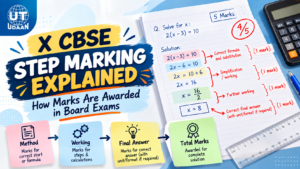
But remember, board marking schemes often award marks for:
- Method
- Steps
- Working
- Diagrams
- Correct formulae
Smart Tip
- Always write something meaningful.
- Show your calculations.
- Draw a relevant diagram whenever possible.
- Write the appropriate formula even if you’re unsure of the final answer.
Key Takeaway: Never leave a question blank. Partial answers can still earn valuable marks.
Mistake #6: Skipping Revision
Many students spend the entire exam writing and submit the paper immediately.
However, the final 10–15 minutes are often the most valuable.
During revision, you can catch:
- Unanswered questions
- Calculation errors
- Spelling mistakes
- Incorrect question numbers
- Missing units
- Forgotten labels
Smart Tip
Reserve the last 15 minutes exclusively for revision.
Think of it as your “Mark-Saving Time.”
Key Takeaway: A quick revision can recover marks that would otherwise be lost due to avoidable mistakes.
Mistake #7: Avoiding Mock Tests
The more papers you write, the more confident you become.
Confidence isn’t built by reading.
It’s built by practicing.
Mock tests help you:
- Improve speed
- Build confidence
- Manage time effectively
- Reduce exam fear
- Identify weak topics
- Practice answer writing
- Learn from mistakes before the real exam
Key Takeaway: Practice under exam conditions so the actual board exam feels familiar.
Bonus Tip: Learn from Every Test
Don’t just look at your marks.
Analyze your mistakes.
Every corrected mistake today is one less mistake in your board exam tomorrow.
The Success Formula
Board exam success isn’t just about studying harder—it’s about avoiding common mistakes.
Small improvements in planning, presentation, revision, and practice can add up to a significant increase in your final score.
Ready to Test Yourself Before the Real Board Exam?
Want to identify these mistakes before your actual board exam?
Take the UT Udaan Full-Length Board Test Series.
Our tests are designed to:
- Simulate the real board exam environment.
- Provide detailed performance analysis.
- Improve your speed, accuracy, and confidence.
- Help you identify weak areas before the final examination.
Small improvements in every test lead to big results in the board exam.